terminal
I have seen the present, and it is Heathrow Airport’s Terminal 5. A rant.
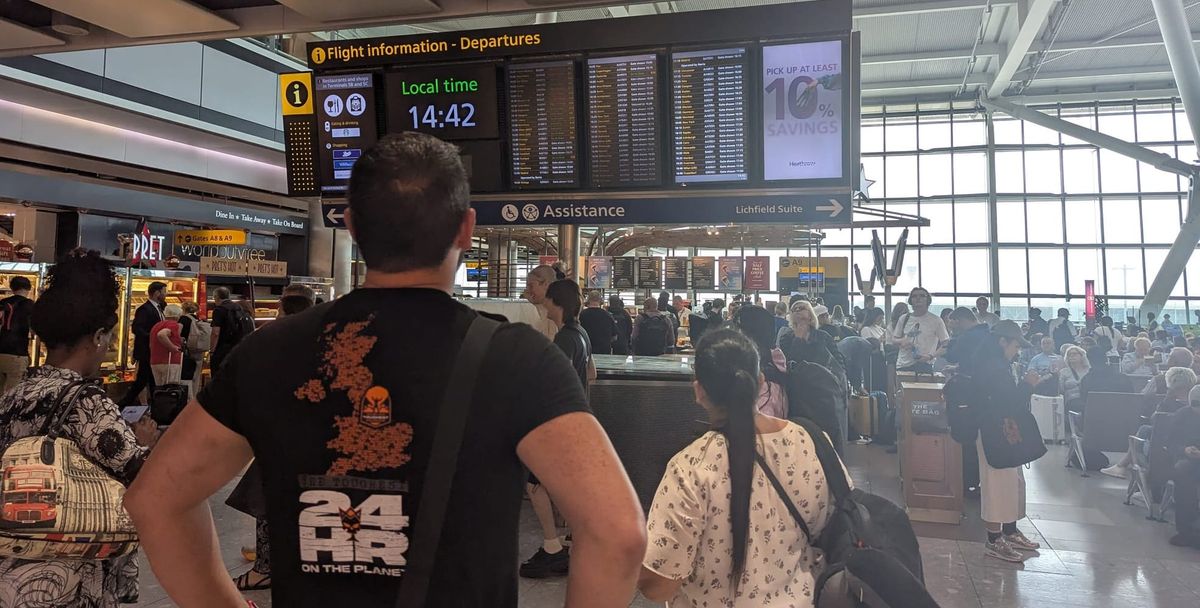
I was cleaning up my drafts folder the other day and came across this one from last summer that I’d meant to post and never got around to finishing up. Here’s a dispatch from the UK to give you a break from Mexico. Content warning: Rant.
I have seen the present, and it is Heathrow Airport’s Terminal 5.
I had left New York at 11 pm. We landed in London at 11 am, British Summer Time. My experience was unquestionably exacerbated by fatigue. Nevertheless, Heathrow Terminal 5 is awful. Worse, all of its awfulness is awful in ways the world is awful, just intensified and concentrated in one building.
As we got off the plane - disembarked, to use the British term - we were told to follow purple signs. It was the last spoken instruction for thirty minutes of herding, down a hall to an escalator, to three more escalators, to an underground train, up two escalators, down bleak corridors with white walls and linoleum floors and occasionally a poster declaring someone proudly African. Along the way we would pass various people wearing Heathrow uniforms, mostly purple fleece vests. None of them spoke. I could ascribe that to the international nature of Heathrow, Terminal 5 specifically, but on the other hand none of the signs were in a language other than English. Twice I showed my boarding pass to a machine. The first machine had a gate, but at the second neither a human nor a mechanical device appeared to care whether I actually showed my pass or not.
Eventually we arrived at a security checkpoint. A woman making sure our luggage was properly placed in bins avoided eye contact, said nothing, smiled never. That might be cultural; almost no one at Terminal 5 smiled, not even the people trying to sell me things. I was behind a mob of teenage girls gumming things up with their teenage combination of not understanding and not caring. Finally I put my things in the bin and made eye contact with the woman on the other side of the conveyor belt; I smiled at her. Her expression did not change.
At the body scan a burly man spoke to me. “Nothing in your pockets? No belt?” I raised my shirt to show him no belt, only the ten extra pounds I carry with me. He didn’t smile. He told me to grab two rails and step on a machine. It blinked green at me. I was allowed to take my bags and go.
From the security checkpoint the mob and I were expelled into a shopping mall. It held the usual collection of airport stores: newsstands, overpriced bottled water, overpriced electronics, duty-free liquors and perfumes. Other stores seemed selected to make us think we were in England: Boots the Chemist; Harrod’s. Harrod’s offered a Canada Goose parka for £1,200. I passed.

I took an escalator down. More stores; the same brands and new ones. Terminal 5 proved to consist of a long corridor, narrowed by the crush of oversized and unnecessary emporiums on either side. A sign promised a quiet area; it was not. Another pointed to the pay-for-use lounge.
The architecture of Terminal 5 is the standard, engineering-forward airport architecture of 20 years ago. Exposed structural elements. Ceilings that reveal the ductwork and conduits and cross-members above. A palette of gray and lighter gray, interrupted by British Airways blue on temporary dividers and tension barriers. Every bit of it is as anodyne as it sounds.
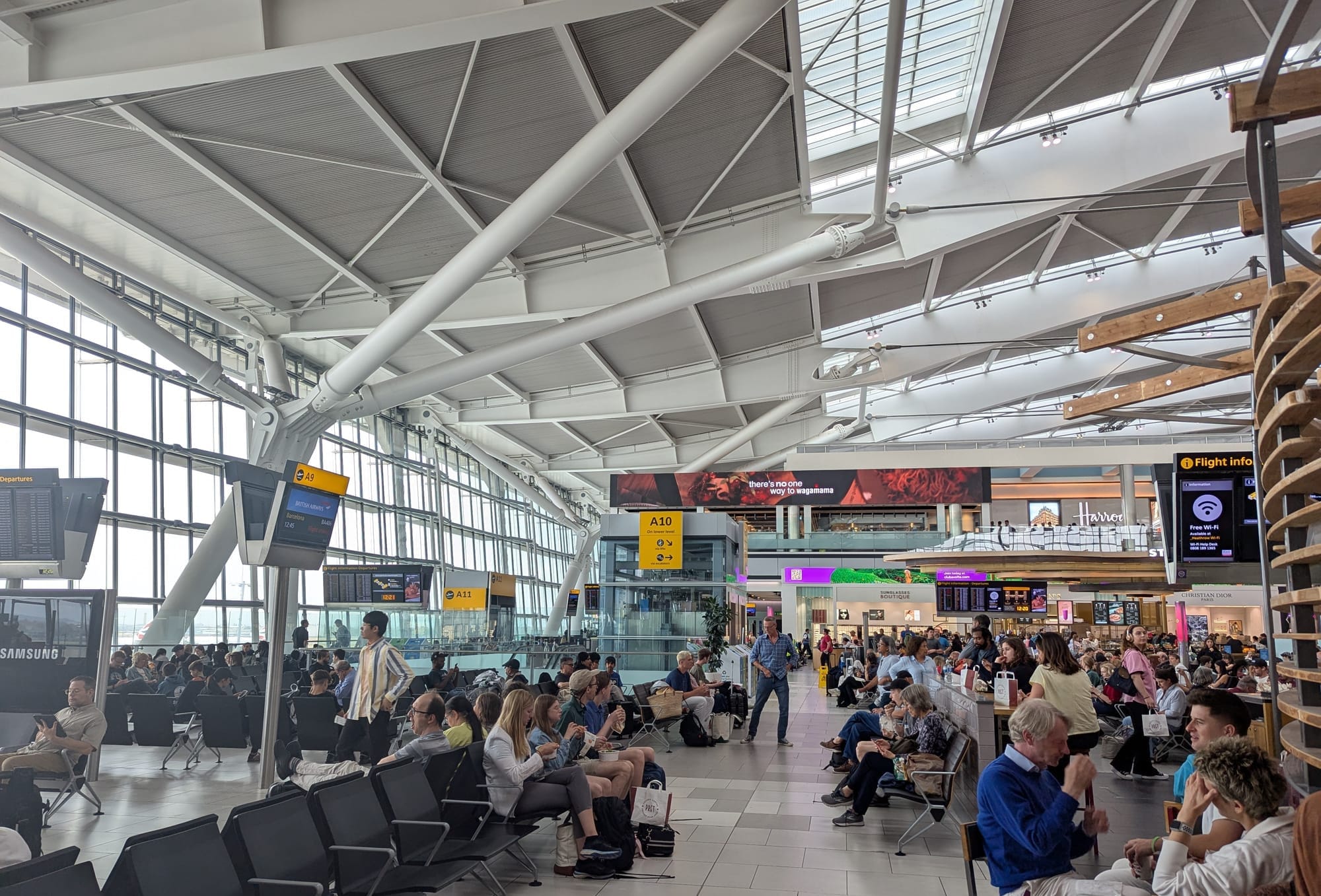
In the midst of this: Us. Too many people, none of us quite sure where we were supposed to be going. Most of us with too much time on our hands, thanks to airline economics. All of us crowded into too-narrow corridors, looking for restrooms, looking for tolerable food, distracted by InMotion and W.H. Smith as we hunted our gates, trying to decide between Starbucks and Pret A Manger. All of us thoroughly trained in the arts of not talking to each other, not making eye contact, not smiling, not acknowledging each other as we collided with each other while attempting to read gate numbers and departure times. No one made an effort to move out of the way; no one said “excuse me.” We were very tired, we were very unhappy, we had gone back and forth all night on planes and were a little angry about it.
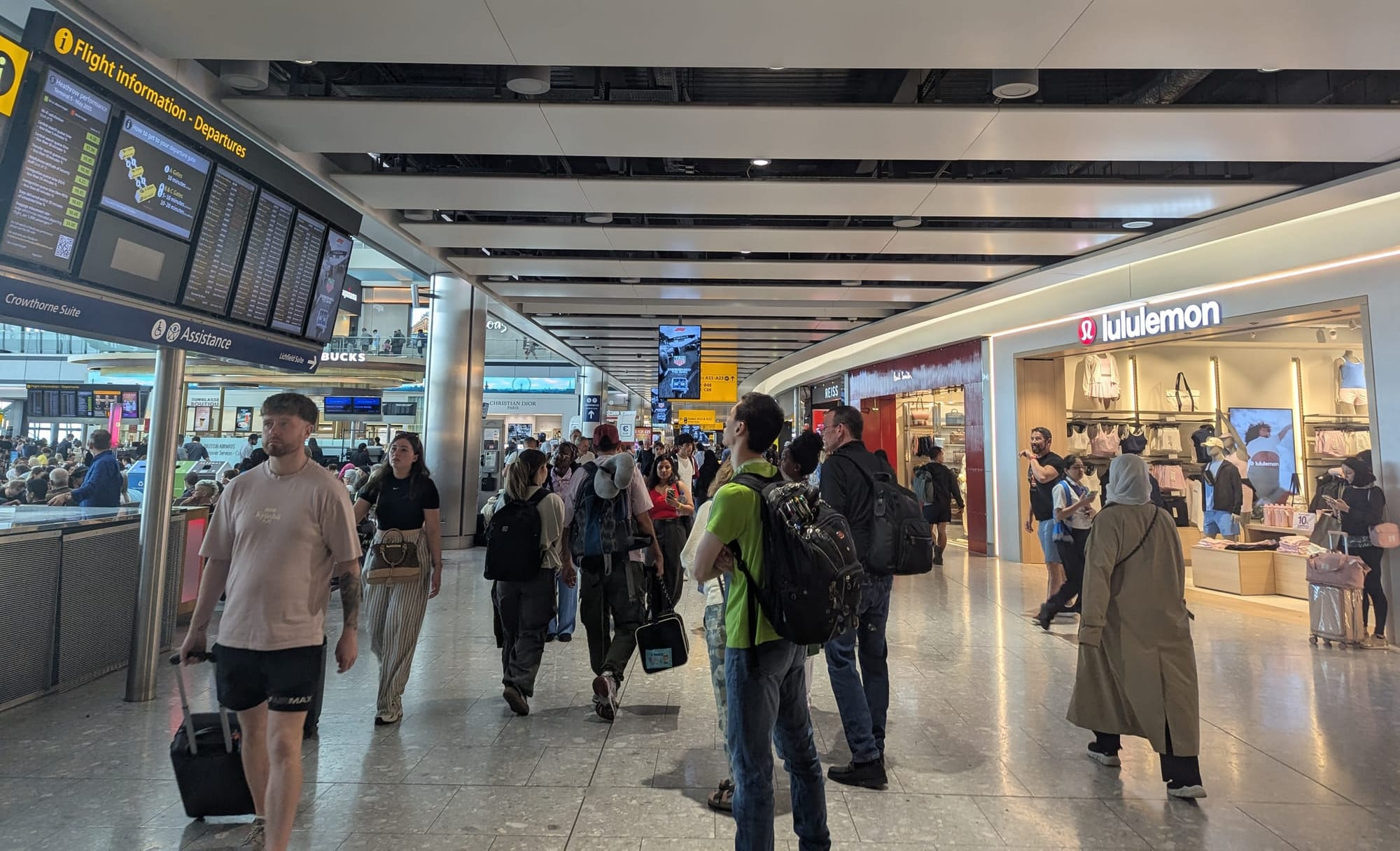
As I said: This is the world, concentrated. It’s rare that you get to see it all together like this, especially the replacement of humanity with technology; the replacement of interaction with commerce; the replacement of pleasure (let alone joy) with distraction. The capitalist instinct to squeeze out public spaces in the interest of revenue: shitty waiting areas motivating the masses to spend £50 for two hours of advertised comfort.
One could ask how we got here, and in part we have Margaret Thatcher to thank; she engineered the sale of Britain’s airports, along with various other public assets, to private hands. Britain’s airports may well have sucked before their sale, so I won’t say it’s only that. Anyone who has been to the various terminals at Kennedy Airport, still managed by the Port Authority of New York and New Jersey, can attest that government alone is no panacea.
We have a bigger problem here, though. My psychology professor once commented, looking at the sprawl of strip malls surrounding Mount Vernon, Ohio, how sad it was that it had grown that way without anyone designing it. And that if someone had planned it the way it turned out, that would be sadder still. Accordingly, I'm not so cynical as to think all of Heathrow's hostility to human life is by design; no one said, “Let’s build the worst public amenity we can conceive.”
It’s more like this: In my theater days, we would play various games devised by Augusto Boal to unlock creativity and break the way we are accustomed to seeing the world. I've written about Boal a lot if you've been following along.
In one of them - one of the more basic ones, easy to learn - one person, volunteering at random, would begin the game by making a sound and a motion. Like, going “toot!” and thrusting their hand in the air. And then they would repeat it, over and over, nonstop. After a while another of the group would join in, adding their own sound and motion that in some way responded to the first - maybe appearing to be driven by the first person’s activity, or maybe their own thing somehow just aligned with the first. And so on, until every member of the group was part of this assemblage, making noises and repeating movements that harmonized or contrasted but in some way were synchronized. And we would step back at the end and applaud our ability to cooperate and construct this machine that did - nothing.
After a couple times playing this game I came to hate it. Then I came to hate the way participants - sometimes including the facilitator - would fail to see what it was actually demonstrating. It was so easy to fall in line. It was so easy to applaud yourself for falling in line. To hear and see a pointless sound and motion and join in, add your own, feel a sense of accomplishment for making everything work. And not question the purpose.
That game needs a Luddite to come in and smash the machine, every time.
Nobody wanted to make Heathrow awful. Airlines adopted hubs in the name of greater profit. Architects designed buildings to look sleek and cool. Efficiency experts maximized signs to minimize staff, and make the remaining jobs ones that could be filled by the most minimally qualified among us. Technologists designed ever more foolproof machines, replacing human trust and human intuition with biometrics. We ended up with a machine full of repetitive sounds and motions, crushing the souls of everyone it encounters.
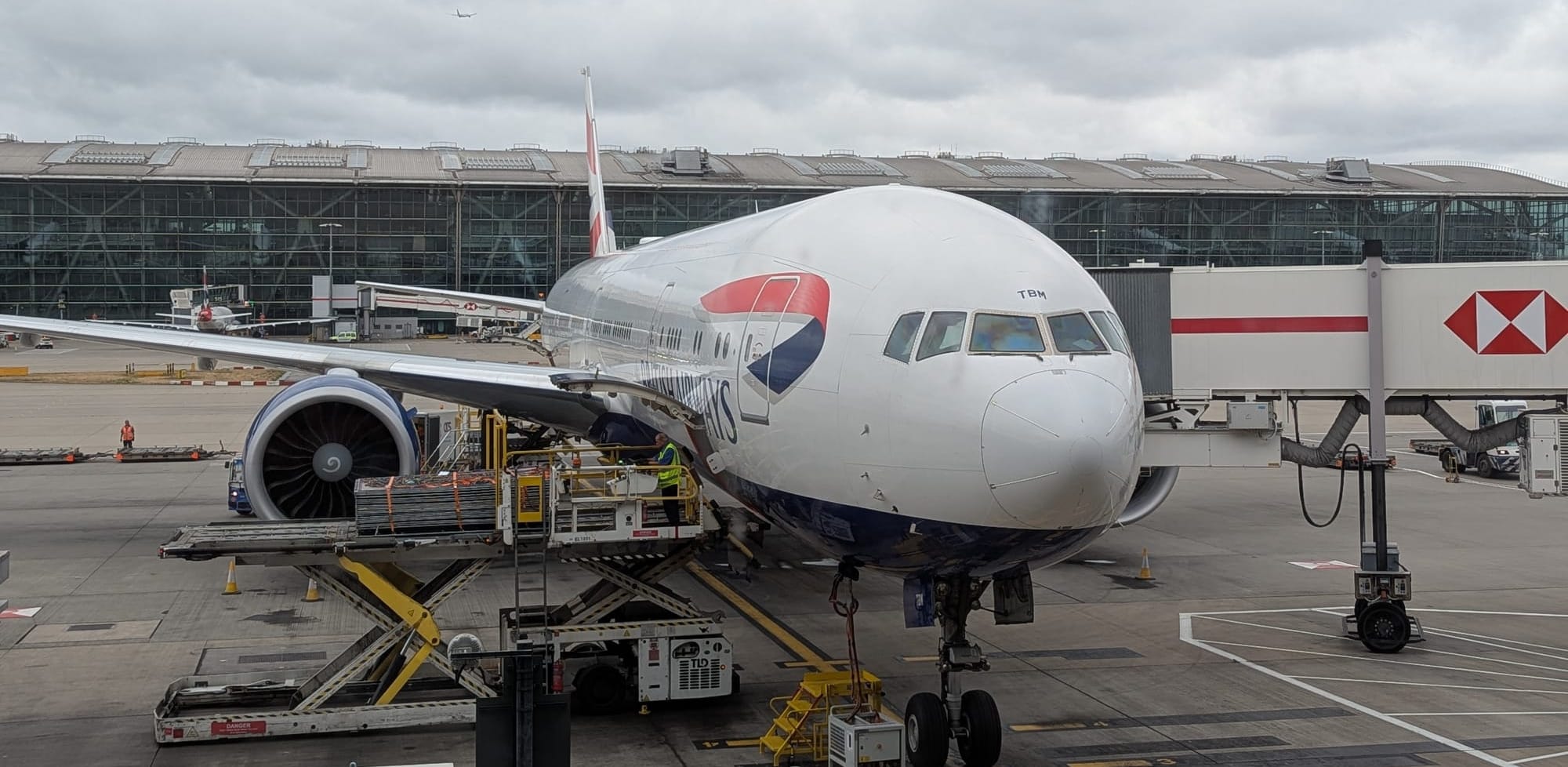
The machine of Heathrow doesn’t do nothing. Eventually, after eight hours there, I boarded a flight to South Africa. At the cost of eight hours spent in the opposite of a society.
In the middle of Terminal 5, a bit toward one end, sits a restaurant that tries to capture the atmosphere of a British pub. The menu lists, vaguely, pub food; tables are separated by shelves with 19th-century artifacts. The whole of the restaurant is marked off and separated from the narrow passageways of the terminal by fake brick walls, ending mid-torso so you can be tempted by the sight of fish and chips and mushy peas, or maybe just by a seat that for a few minutes will belong to you and you alone.
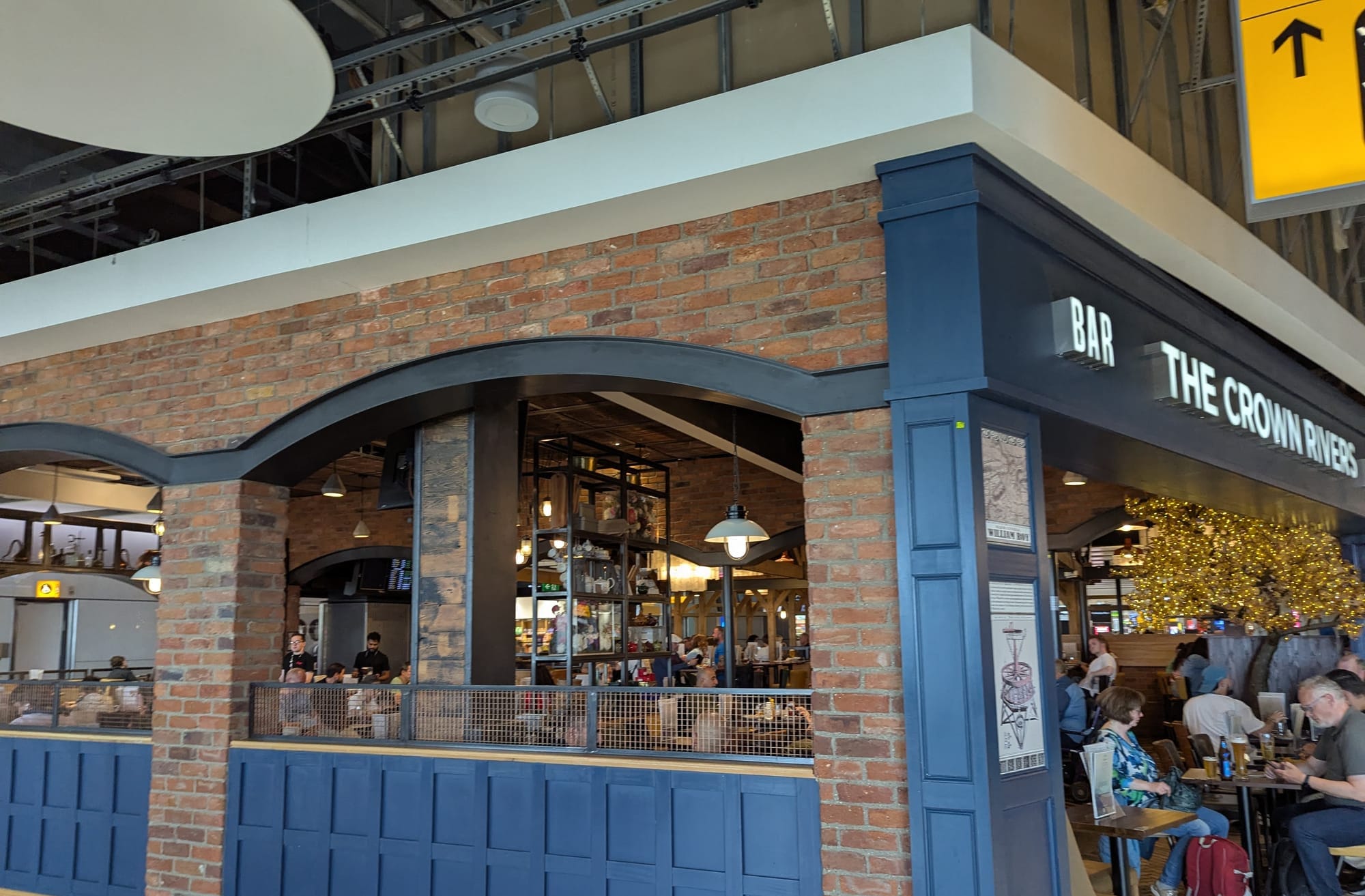
Interspersed are brick columns topped by arches that hold up - air. They call to mind the story about columns that the architect Christopher Wren supposedly installed at the Windsor Guildhall, having been ordered to do so because the town’s officials thought his design lacked the structural support it required. Wren, it’s said, had the columns built but left them an inch or two short of the ceiling.
That story is apparently too good to be true. The columns at Heathrow, however, are real and intentional enough - designed to support an illusion of humanity amid the machinery of modern life.