the weight of the present (dispatch #4)
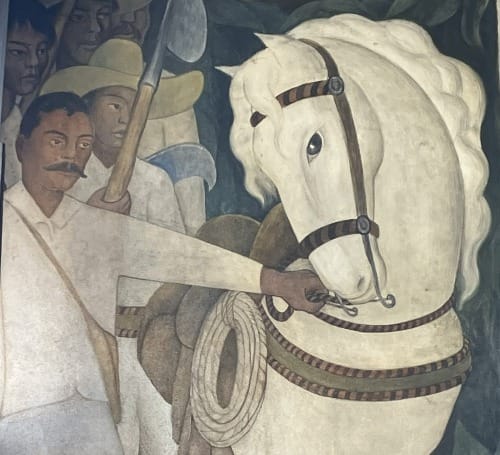
I’m reading a history called Mexico: Biography of Power 1810-1996 by Enrique Krauze. It’s a beast, 800 pages not including notes. It added considerable heft to my luggage. This is my third go at it, and I’ve at least managed to finish reading the introductory section, “The Weight of the Past.” (The joke writes itself.)
So far it has been worth trying this third time, as my understanding of things has changed - about Mexico, about the way I was taught history, about viewing events from different perspectives. And as I watch events unfold in my home country.
The part called “The Weight of the Past" is a kind of primer on Mexican history prior to 1810, for us dopes who either didn’t pay attention in school or weren't given the right stuff to pay attention to. Krauze summarizes five elements of that past: “The Children of Cuauhtémoc” (the last emperor of the Aztecs) and “The Legacy of Cortés” (you know him) meet in “The Mestizo Family.” Across these threads are woven the Church and the Crown. And Krauze’s overriding theme - which surely reflects the historian’s thumb on the scale - is the question of legitimacy - who really “owns” Mexico; who can legitimately claim to be “Mexican.”
Maybe you see where this is going.
Mexico’s history remains confusing to me, and a comprehensive history of Mexico remains something I need to read, in part because of the series of invasions and revolutions and counter-revolutions that don’t obviously have parallels in the United States. You walk through Mexico City and see street names that are dates: “16 de Septiembre,” “5 de Mayo,” “20 de Noviembre.” I can tell you what happened, more or less, on Cinco de Mayo. The others were ... something. I hope there’s not a test at the end of Krauze’s book.(1) Even before these events, however, came all the changes in authority and influence in New Spain. The waxing or waning power of the Catholic Church, and within it the various orders, especially the Jesuits. The attention or inattention of the Spanish king (or Spain’s need to appropriate Mexico’s wealth). All these would lead to shifts - subtle or dramatic - in who counted.
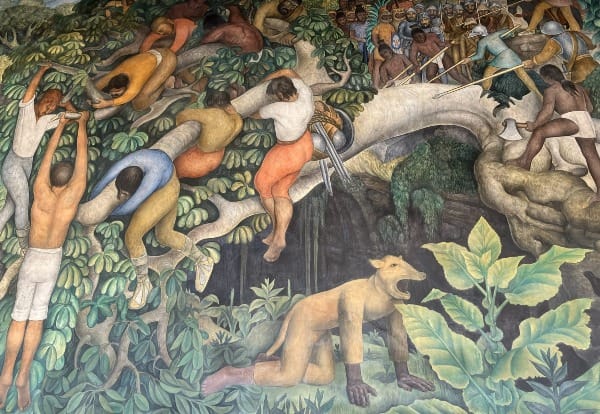
For example, mestizo people. Typically born out of wedlock and, as Krauze says, “rejected by the Indians as Spanish, by the Spanish as Indian....” But it was possible to be legitimized - Cortés himself had an indigenous mistress; their son became legitimate through a papal bull.(2) That might confer on a person roughly the status of a Criollo, a person of European heritage born in the Americas, but not that of the elite, those born in Spain. It gets more complicated: enslaved people from Africa; children of enslaved people and indigenous people, who were themselves not born into slavery; indigenous people who converted to Catholicism vs. those who did not. (I won’t repeat the whole book here; you can lug it around yourself.) And all this without entertaining a legal concept like “citizenship,” or for that matter the psychological concept of “Mexico” as a unified place (let alone a nation), which from the 16th to 18th century, didn’t really exist - until it did.
Again, Krauze’s version of things.
And that ongoing conflict continued - I haven’t gotten to that part of the book, but my sense is that it continued - through the various revolutions, the attempts at recolonization by the French, the actual colonization of half of Mexico by the United States, and through peaceful or quasi-peaceful transfers of power - even, from my naïve perspective, through the transitions from the long supremacy of the political party PRI to its successor PAN to, in the last decade or so, the sudden ascendancy of the National Regeneration Movement (“MORENA”) under Andrés Manuel López Obrador and Claudia Sheinbaum. Who rules, who counts, who gets to call themselves “Mexican”? In effect, who does Mexico belong to?
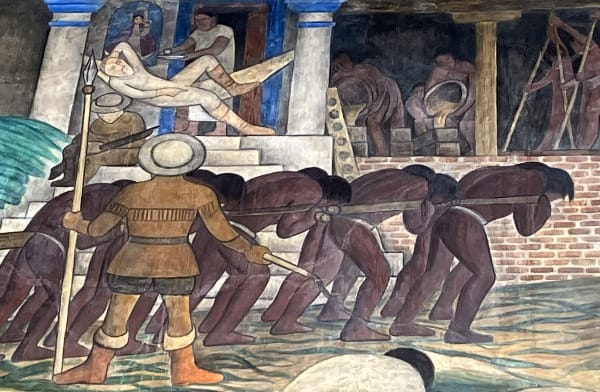
One more time: The little I know about this stuff mostly comes from reading one part of one book by one author.
I know a little more about the history and ideology of the United States. We had a revolution and that made everybody Americans. OK, not everybody; certainly not everybody was a citizen in the important sense of being able to vote, but everybody counted. Well, some people counted only one-third, and the people who were here prior to Europeans were members of other nations, not the United States, but -
Like, we know that story, and when I’ve thought about how I would like to teach “American” history - thematically rather than simply chronologically - the fight to expand the franchise would be front and center. It’s not a story without flaws, obviously. But, whereas Mexican history looks to me like a spiral, one that keeps encountering the same cycle of revolution and revanchism, the phrase “the arc of history” has had purchase in describing the story of the United States.
Until now, and by “now” I mean after a year - it hasn't even been a year, kids - of watching our own cycle of revanchism take hold, and also after a week of watching events in the U.S. from my perch in Mexico, and reading eighty pages of a weighty tome that describe an ever-shifting understanding of who really counts.
Look again: The colonial history of accommodation, and then eradication, of indigenous Americans. A revolution in which all men were declared equal (except some). A civil war fought, in part, to rectify that last part, and the remaking of the Constitution that followed. The counter-offensive of Jim Crow, whose midwife was that onetime Worst President Ever who has a statue in the center of my hometown. The fight for voting rights for women. The slow and then sudden revolution of the Civil Rights Movement, followed at once - in the timeline of a nation’s history, at once - by the deliberate, and now sudden, effort to crush that movement under Reagan and Trump.
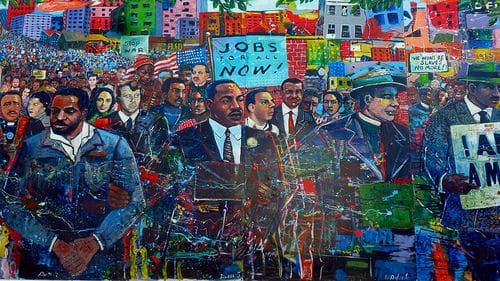
Less an arc than a bumpy road.
We don't put up street names to mark the dates of these events; I can’t tell you the date of the attack on Fort Sumter (if that’s the important event; maybe instead I should be saying October 16, when John Brown put into motion his one-man war). We honor the men, sure, both the Rutherford Hayses and the Martin Luther Kings, but we honor them as men who acted, for good or ill, under the aegis of our Constitution. (For this reason, perhaps, Brown remains a bit of a pariah; to honor him gives the game away.) In the same way, marking the dates - the actual dates, not just choosing the last Monday in May - would suggest a little too loudly, “Here is the moment when things broke.”
We don’t like to talk about things breaking. We want the national myth to be clean and smooth. There was the Fourth of July, and then everything after.
Maybe that’s changing. The date January 6, one way or another, appears as if it may last in memory beyond the current generations. I wish I could have confidence in the story future historians will tell, but that was not an opportunity afforded to Cuauhtémoc, nor Cortés, nor José María Morelos, Benito Juárez, or Emiliano Zapata, and neither is it afforded to us.
And this latest battle - for once, “battle” is the right term; not politicians speechifying but armed government thugs killing citizens, and arresting and deporting and sometimes also killing others who may or may not count, depending on your point of view. This actual battle is more than ever about who counts, who gets to call themselves American. And to whom the United States belongs.
(1) May 5, 1862, was the date Mexican forces repelled the invading French army at the Battle of Puebla. September 16, 1810, was when Father Miguel Hidalgo y Costilla issued his “Grito de Dolores,” calling for Mexicans to revolt against Spanish rule. November 20, 1910, was the date chosen by Francisco I. Madera for Mexicans to rise up and depose President Porfirio Díaz, who had governed as a dictator since 1876.
(2) That mistress, Princess Malintzin, is infamous in Mexican history; she began as Cortés’s translator - bad enough - and later plotted against Cuauhtémoc. She is now known as La Malinche, which has become a synonym for “traitor.”
Photos of murals by Diego Rivera at the former Palacio de Cortés by the author.
Painting of Martin Luther King, Jr., and other civil rights leaders by Louis Delsarte, from the Civil Rights Movement Archive at https://www.crmvet.org/images/imgart2.htm
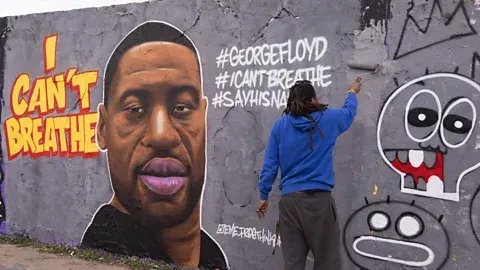
George Floyd mural in Berlin by Eme Freethinker; photograph by Abdulhamid Hosbas/Anadolu Agency/Getty Images, at https://www.bbc.com/culture/article/20201209-the-street-art-that-expressed-the-worlds-pain