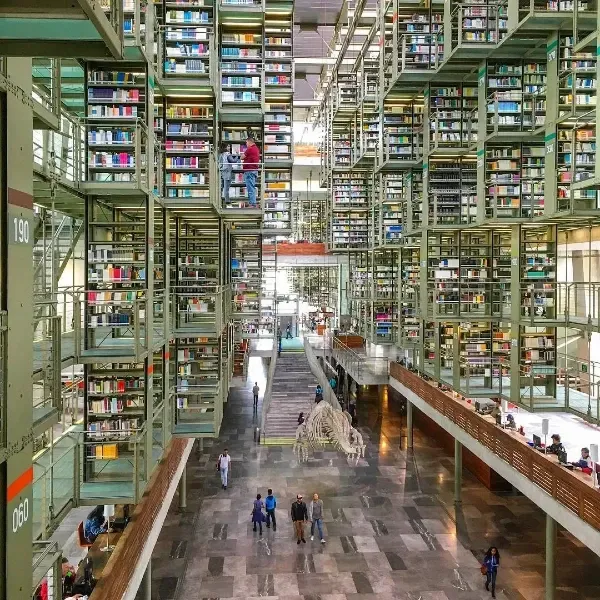
biblioteca (dispatch # 13)
The library has always been my favorite place, as a child and here in Mexico.
I grew up in the library. This one in particular …
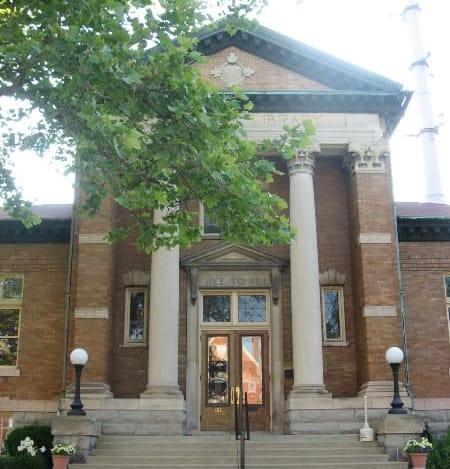
… which now houses various government functions, the library having moved to a more functional but less romantic building in a decidedly less important corner of downtown Delaware, Ohio. The old one, the one pictured, followed the classic Carnegie Library arrangement: children’s books on the right, the adult reading room on the left, stacks behind, and the librarians’ desk right in the middle. They sized you up as you entered, eyed you while you read and shushed you when you weren’t reading, stood ready to answer any old question you might have.
Andrew Carnegie during his career may have been every bit as horrible as any of the billionaires of the current age. In retirement and afterward, he used the fruits of his horridness to remake the civic landscape in a way that no one not named Roosevelt has ever done. By the time I was walking through the big oak doors on North Sandusky Street, or even more so making my way through little towns across the United States, the idea of a public library was so thoroughly embedded in my consciousness, so commonplace, that it took me by surprise when I realized that not every little town in Mexico has a building full of books, “free to all,” right on the Zócalo where it should be.
And consequently, it took me a while to figure out where the public libraries in Cuernavaca are. I would go to those little towns in the United States and be able to find the library in minutes. Here it took me weeks. I asked friends, where is a library where I can work? And they would get a slightly puzzled look on their face, or maybe answer where one was, but they wouldn’t know anything about it. A building around the corner from my apartment bears the word biblioteca over the door. I asked Martha about it; “It’s a library?” Supuestamente, she replied. Some time later I looked in. I found no books, no reading room, no one resembling the hawk-eyed librarians who used to watch over me in Delaware.
I could say it frustrated me, but more than that it made me sad. It set me off on a search. What I found are perhaps my two favorite places in Mexico.
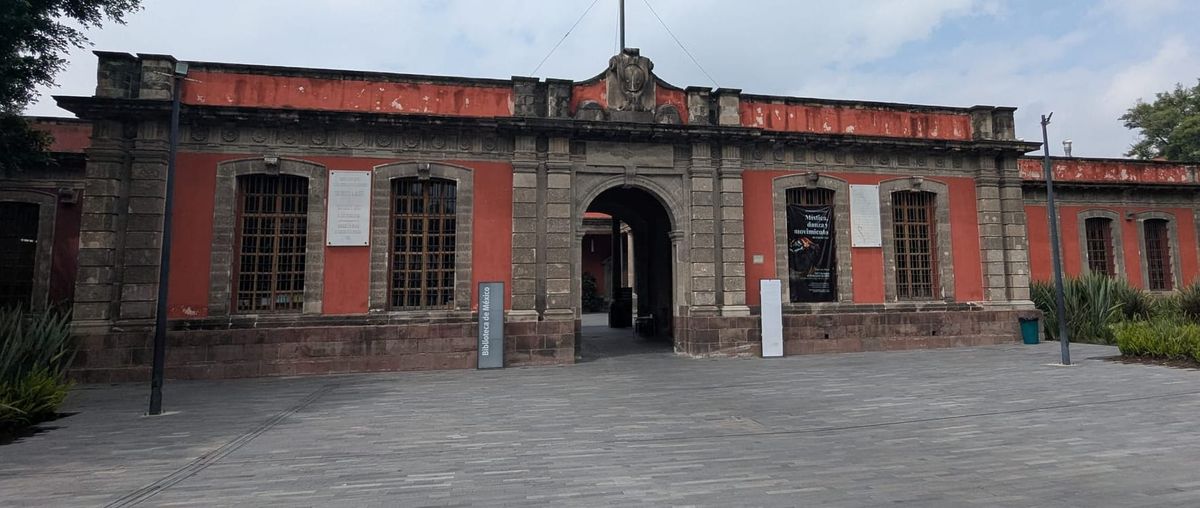
I found the Ciudadela by accident. Formally it’s the Library of Mexico, but it’s the Ciudadela to me, and if you want to tell someone where you’re going or where you’ll be, that name seems to work better. I was looking for the Parque de Danzón, across the street, which I’ve written about before and will again. Or maybe it was the “artisanal” market across the street, also called the Ciudadela, a collection of vendors selling genuine crafts, and even some workshops where they make them, alongside other stalls full of the usual tourist junk. At some point I started wondering what that red building on the other side of the statue of Morelos was, and wandered over to find the sign identifying it as the Biblioteca de Mexico. (1)
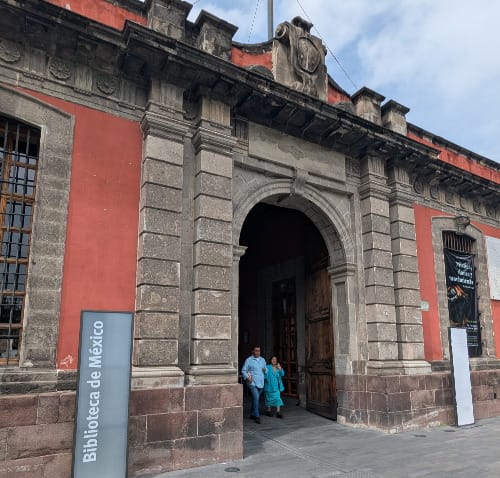
It’s a magnificent building: a ruin, a feat of engineering, and a warm and gorgeous repository of knowledge at the same time. It’s like all of Mexico City that way, where the Cathedral sits on top of and next to the Mexicas’ Templo Mayor, made out of the same stones. Down a street named for a historical event or a president or a historian soars the Torre Latinoamericana, built in 1956 and still the city’s most iconic skyscraper, though no longer its tallest. Down the street from that is the most modern line of buildings you could want to see, all along the path the Empress Carlota had constructed so she could see her husband Maximiliano ride off to work at the National Palace while she slowly went mad. The whole city stands as proof that the past isn’t even past.
The Ciudadela encapsulates that in a city block. Despite its fortress-like appearance, it was built to be a tobacco factory. That apparently didn't last long: the factory was finished in 1807, but after the Mexican War of Independence started in 181o, the Spanish government took it over for use as a military barracks and prison. It was sometime after this, I suppose, that it acquired its name, which means “citadel.” Among the early prisoners was José María Morelos y Pavón, the leader of the War of Independence after Father Hidalgo was captured and executed. Like Hidalgo, Morelos was captured by the royalist forces. They brought him to the Ciudadela, where a plaque on the outside wall now honors him.
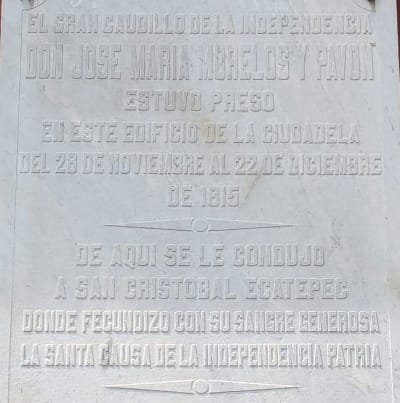
The great Caudillo of Independence, Don José María Morelos y Pavón was imprisoned in this building of the Ciudadela from November 28 to December 22, 1815.
From here he was taken to San Cristobal Ecatepec where he nourished with his generative blood the sacred cause of national independence.
One hundred years later, the Ciudadela performed a similar role in the Mexican Revolution. During the Decena Trágica, the Ten Tragic Days, president Francisco I. Madero was tricked by his general, Victoriano Huerta, into attending a meeting at the Ciudadela. Instead he was seized, forced to resign the presidency, and carted across town to the prison where he was assassinated four days later.
The Ciudadela encompasses four large patios where, I suppose, workers piled sheaves of tobacco and later soldiers stood for their morning formation. Each now is covered with a trussed roof, standing independent of the historical structure like four giant, flat umbrellas. Three of these patios house racks of books. The fourth bears the name Patio de los Escritores, connecting five personal libraries of Mexican writers that occupy the outer building. It’s decorated by massive busts of noteworthy writers, all of them names you would likely know, all of them men.
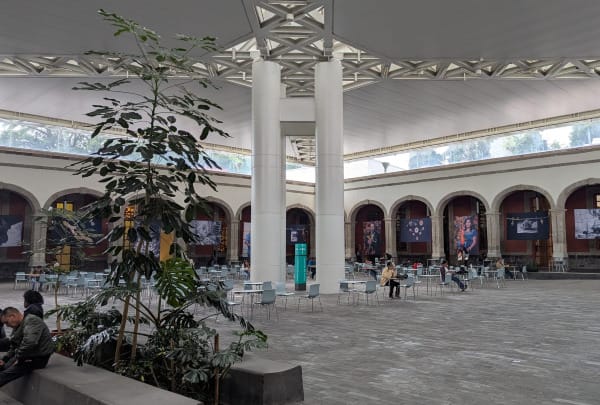
To the library, it’s a multi-purpose room for events and expositions. To me, it’s a place to write and tell myself I belong in that company, whether that will ever be true or not. It’s good to have their example. It’s good to have the company of others doing the same thing.
In Cuernavaca my hunt for libraries was more intentional; I needed a place where I could write that didn’t turn into a greenhouse in the morning sun, and where distractions were less readily at hand. Unfortunately, the biggest public library in Cuernavaca is located not, as it should be, on top of the hill next to the Cathedral, or in the former Palacio de Cortes, but off in the Parque Alameda several miles away. I still haven't made it there.
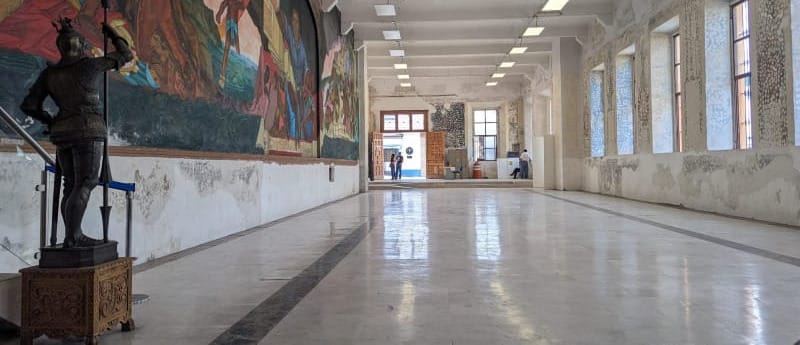
Various searches on various sites gave me different suggestions. One I tried, a supposed art library with some connection to the university, turned out to be a long, empty room with an enormous mural and a porter who made me empty my bookbag and carry everything to a table at the far end, and then put my now-empty mochila in a locker. I didn’t return.
Where I have returned, at least weekly since my first visit, is to the dark and lovely library in the Juan Soriano Morelos Museum of Contemporary Art.
The MMAC - that’s Museo Morelense de Arte Contemporaneo - looks like a lot of building for the amount of exhibition space it holds. It looms over the bridge from the centro histórico and Cuernavaca’s main market. The library sits at the bottom of a ramp, underneath the main gallery and across the hall from the gift shop.
It’s a simple cube with three floors, the upper two ringing an open center, accessed only via a spiral staircase. I usually sit on the main floor, but sometimes the kind woman who manages the information desk tells me an event is happening, and sends me upstairs - which in hilly Cuernavaca brings me back to ground level. From there I can look out at the sculpture garden and the people passing through.
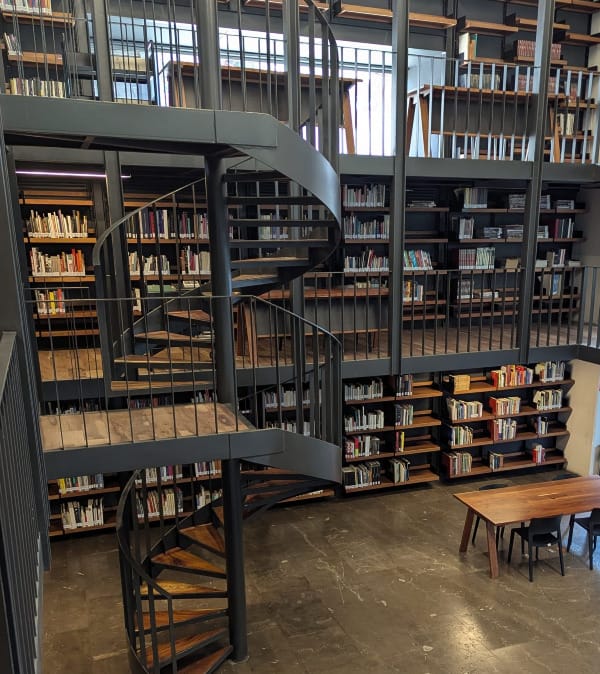
After what feels like a sufficient number of hours of work I’ll go to the lockers and find my lunch - the guards at MMAC, like the porter at the other library, are always asking me to put things in a locker, but the kind woman who manages the information desk in the library waves them off if she notices. And then I’ll walk out to the sculpture garden and sit in the shade and eat my lunch, surrounded by Juan Soriano’s works. Large bronzes, most of them geometrical birds.
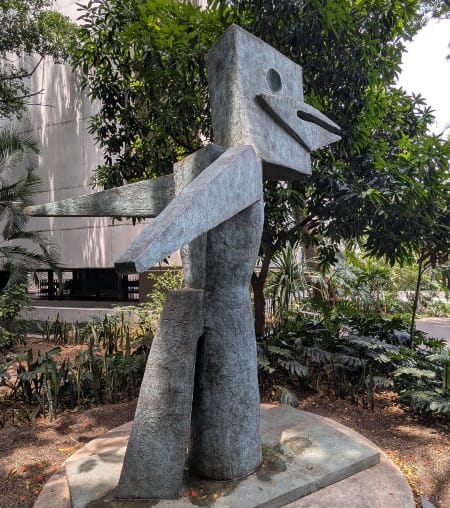
People will pass, seeing me eating my extranjero lunch at an extranjero lunch hour, and maybe they’ll say buen provecho. And then I’ll go back inside to work.
(1) It is not, as I first thought, the National Library of Mexico, which was established by Benito Juárez in a different building in the Centro Historico and now has a modern home at the Cultural Center of UNAM; nor the Biblioteca José Vasconcelos; that was once the Ciudadela’s name but now identifies a “megabiblioteca” that I didn’t know anything about until trying to get the names right while writing this piece.
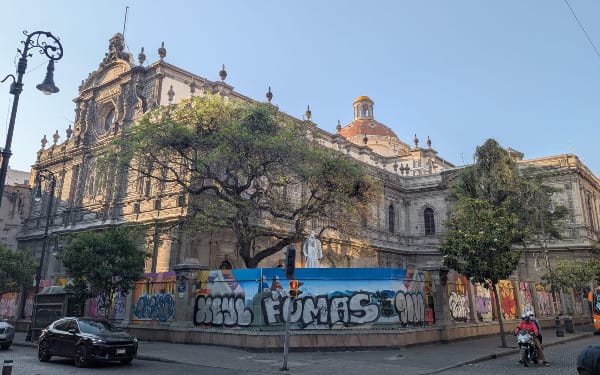
Here’s the original home of the National Library of Mexico, in the former church of San Augustín:
And here’s the Biblioteca Jose Vasconcelos: