vuelta a la biblioteca (dispatch #13.1)
The creation of the Biblioteca Palafox was a radical act, and it remains a symbol and a tool of resistance.
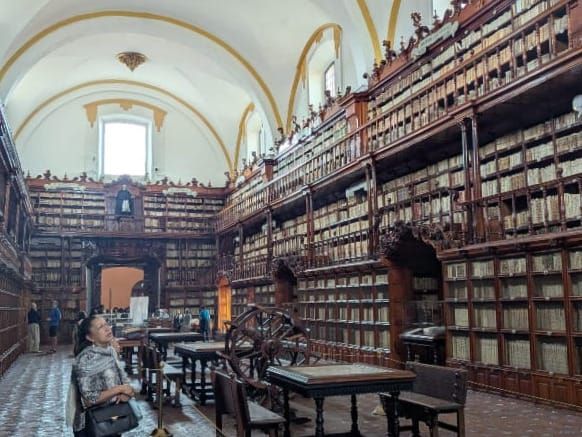
In Puebla, I visited the first public library in the Americas. It was established by a priest named Juan de Palafox y Mendoza in 1646, and his act was radical. He donated his five thousand books to the Colegio de San Juan - which he had also founded - with the proviso that they be made available to the public at large. Perhaps obviously, the number of people who could use these books in Puebla at that time remained small and specific - literacy in New Spain being limited, and further limited the population with the time to visit a library and read.
Nevertheless: a radical act. Like the phrase “all men are created equal,” it immediately brought into the world the tension between the commitment made and the reality of the moment. And like “all men (sic) are created equal,” that tension lives with us and in us still. The Biblioteca Palafoxiana, though in the main a museum, remains open to all who wish to study there. One need only to walk back outside its doors to see the many with no present hope of doing so.
Radical, too, because the Catholic Church wasn’t consistently in the business of spreading literacy and knowledge far and wide, not beyond knowledge of the Bible at any rate. As noted, Palafox was a priest, and part of the Catholic hierarchy. As well, the priests in the villages of New Spain acted more or less as the government. Yet in both roles, he operated in a jurisdictions far removed from any meaningful oversight. And so in both roles, Palafox lived in the tension between the dictates of Rome and Madrid, and the realities of the people he lived among.
The Palafox library contains among its collections an edition of the Encyclopedia compiled by Denis Diderot and Jean le Rond d’Alembert. Our guide explained, as he led us to it, the Church sought to ban it, because its “tree of knowledge” didn’t acknowledge the word of God at the root.
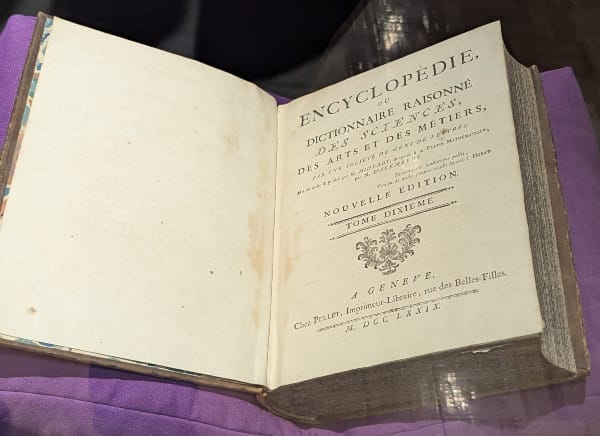
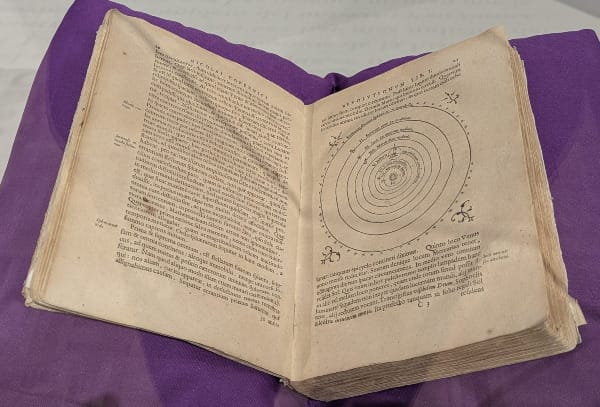
The library had included the Encyclopedie in an exhibit of twenty significant works from the collection, including copies of Gerardus Mercator’s Atlas, Isaac Newton's Principia Mathematica, an early Spanish edition of Adam Smith’s Wealth of Nations, and Nicolaus Copernicus’s Astronomia Instaurata, which also found little favor with the Church. A simply remarkable collection of learning and sharing in one room.
The explanatory note at the entrance to the exhibition reads in part:
In a world saturated with information and digital urgency, to return to the book, to paper, to the silence of the archive and the library is also an act of resistance. To make visible the Palafox legacy is to recall that without memory there is no community, and without access to knowledge there is no liberty.