lawrence of arabia
What is your favorite movie? The answer, for me, is Lawrence of Arabia.
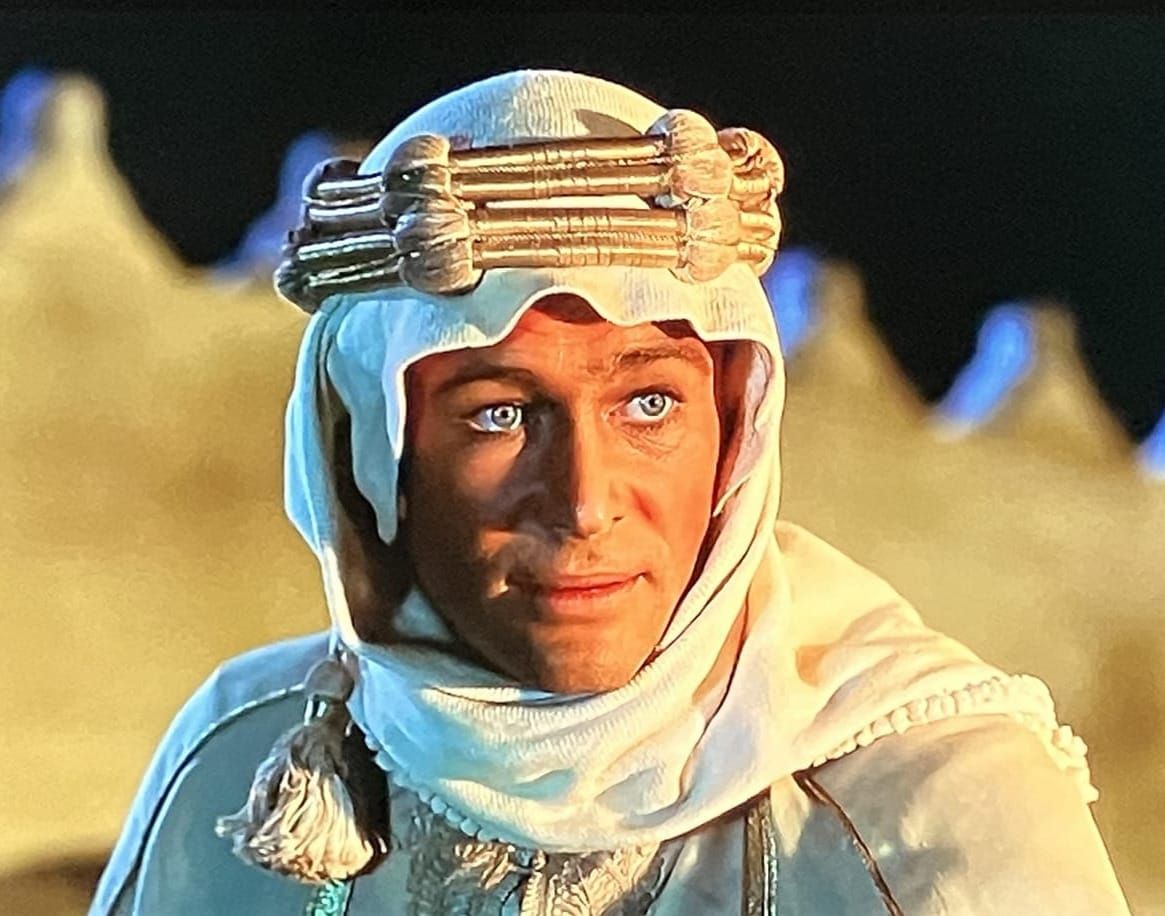
Answering the question “What is your favorite movie?” is a basic life skill. You need to be able to calculate a 40 percent discount in your head. You need to be able to cut open an avocado without slicing the tip of your thumb off. Even in 2026, you should be able to drive stick shift. And you need a ready answer to this question.
Nota bene: Your answer does not have to name your actual favorite film. My actual favorite movie, the one that I would watch instead of any other if faced with the choice of this or that, is probably The Poseidon Adventure.
But the question “What is your favorite film?” that classic icebreaker at workshops or retreats or a first date, is fraught. No one actually cares what your favorite movie is, any more than they care what your favorite food is, or the name of your first pet, or where you would go for your dream vacation. What we want to know is: Who are you? We are going to conclude things about you from your answer. Likely, we are going to judge you.
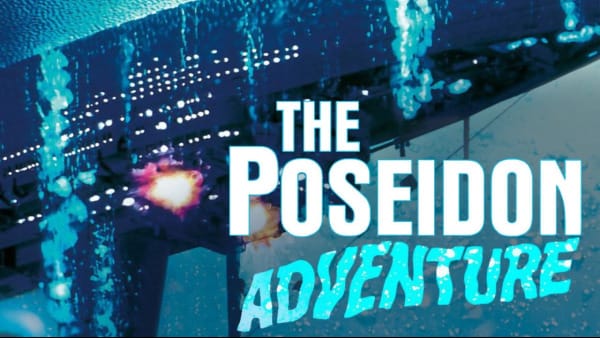
If you answer, “The Poseidon Adventure,” we will assume that you crave action, that you are sentimental, perhaps that you have a tendency toward camp, perhaps that you are as shallow as the Poseidon’s Atlantic is deep. It is, maybe, a bold answer, one that announces I do not care what you think of me. Or careless: This question means nothing to me. Or maybe just honest. That’s always an admirable choice.
What you do not want is not to have an answer to that question. How have you not considered this matter, late at night or in the shower, or at some other conference or first date? Certainly we will draw conclusions from your indecision.
The Poseidon Adventure may be my favorite movie. My answer to the question “What is your favorite movie?” though, is Lawrence of Arabia.
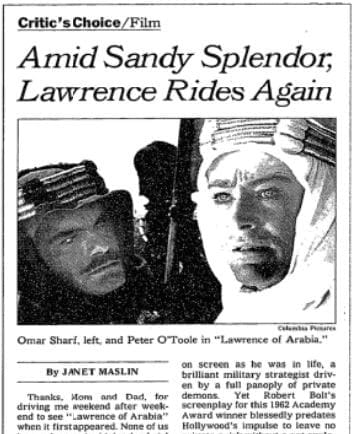
It’s Janet Maslin’s fault. In 1997, she wrote a paean to Lawrence, when it had opened for a revival at the Paris Theater in Manhattan. I found Maslin easy to mock in those days. She seemed to love everything, in stark contrast to her colleague Michiko Kakutani, whose mission seemed to be to dissect and eviscerate whatever poor artistic creature was placed in front of her. To earn that sort of response from Janet Maslin, you had to have produced a truly execrable piece of commercial crap. Recently out of grad school and smarter than everyone, I dismissed Maslin’s tendencies to a friend, older and wiser than me, who pointed out my error. Maslin, he said, simply met everything on its own terms, and judged it not according to some impossible abstract standard but by the simple criterion, did it accomplish what it set out to do?
Whether you mocked Maslin or not, her brief appreciation of Lawrence of Arabia rang out even among the other works she praised. “The movie that led me to fall in love with movies,” she wrote,
is also unimaginably huge by today’s standards. The colossal grandeur of its desert panoramas is well known, but no less towering are some of this story’s more intimate scenes, which link Lawrence’s hubris and humility in such intriguing ways. This film’s main character looms as hauntingly large as its landscape. And the sheer bravado of shooting this film in its pristine, lonely settings is the only special effect.
Not that Lawrence was new to me. I must have seen it with my dad at some point; it was his kind of movie. A war epic, a rebel with a cause, the pursuit of - as the film critic “Robespierre” sneers in Nine - beauty, truth, death, youth, love, life, anguish, angst. (“Love”? That one’s complicated. We’ll get to that.)
Maslin sang a siren call that even I, lashed to my master’s degree, couldn’t resist. And I was newly in New York, eager to devour the culture that every night of the week teemed with. I ran to the Paris.
Like Poseidon, Lawrence of Arabia begins by telling you too much: T.E. Lawrence climbs on a motorcycle and rides, smiling, blond hair flowing in the wind as he speeds toward the crash that will kill him. Cut to a scene of gray men walking out of his memorial service at St. Paul’s. “He was the most extraordinary man I’ve ever known,” one of them - Colonel Brighton, as yet unidentified - tells a reporter. We spend the next four hours judging Lawrence, the man, against that standard.
Lawrence the man? Rather, Lawrence the character, because any small amount of reading will reveal the way director David Lean preferred to print the legend. T.E. Lawrence was larger than life already, but the film somehow exaggerates him to widescreen proportions, invents any number of characters to serve as foils, creates incidents and embellishes others. Lawrence’s younger brother Arnold was apparently outraged at the version of his brother onscreen. But Thomas Edward Lawrence, best I can tell, invented himself on the fly. That Lean would build on those inventions seems a kind of homage. And as a sometime artist and other times critic, I ask, why not? You don’t go to the theater for history, you go for spectacle.
If there is anything that defines this immense, sprawling film, it is spectacle. After Lawrence gets sent to the desert, we see thirty seconds of sunrise - followed by another thirty seconds of long shots of Lawrence and his guide crossing dunes on camels. A full minute of establishing shots. No one would dare do it today - it’s fair to say, I think, no one else would dare to do it then. A minute and a half awaiting the arrival of a rider, interrupted only by two words of dialogue. The interminable ride to Aqaba, across the Nafud desert. Every minute of it gorgeous, not a moment of it wasted.
And in the midst of it, Peter O’Toole. If there were ever a man who deserved the term striking, it was he - striking at thirty as Lawrence; no less striking in his seventies. Maslin called him “impossibly dashing.” O’Toole knew it, and he played a character who knew it, probably, but didn’t know what to do with it. Lawrence tells people, more than once, that he doesn’t know what he is, soldier or politician, Englishman or Arab. Somehow his beauty gives him the confidence - gives them the confidence, character and actor both - to do whatever the hell they want.
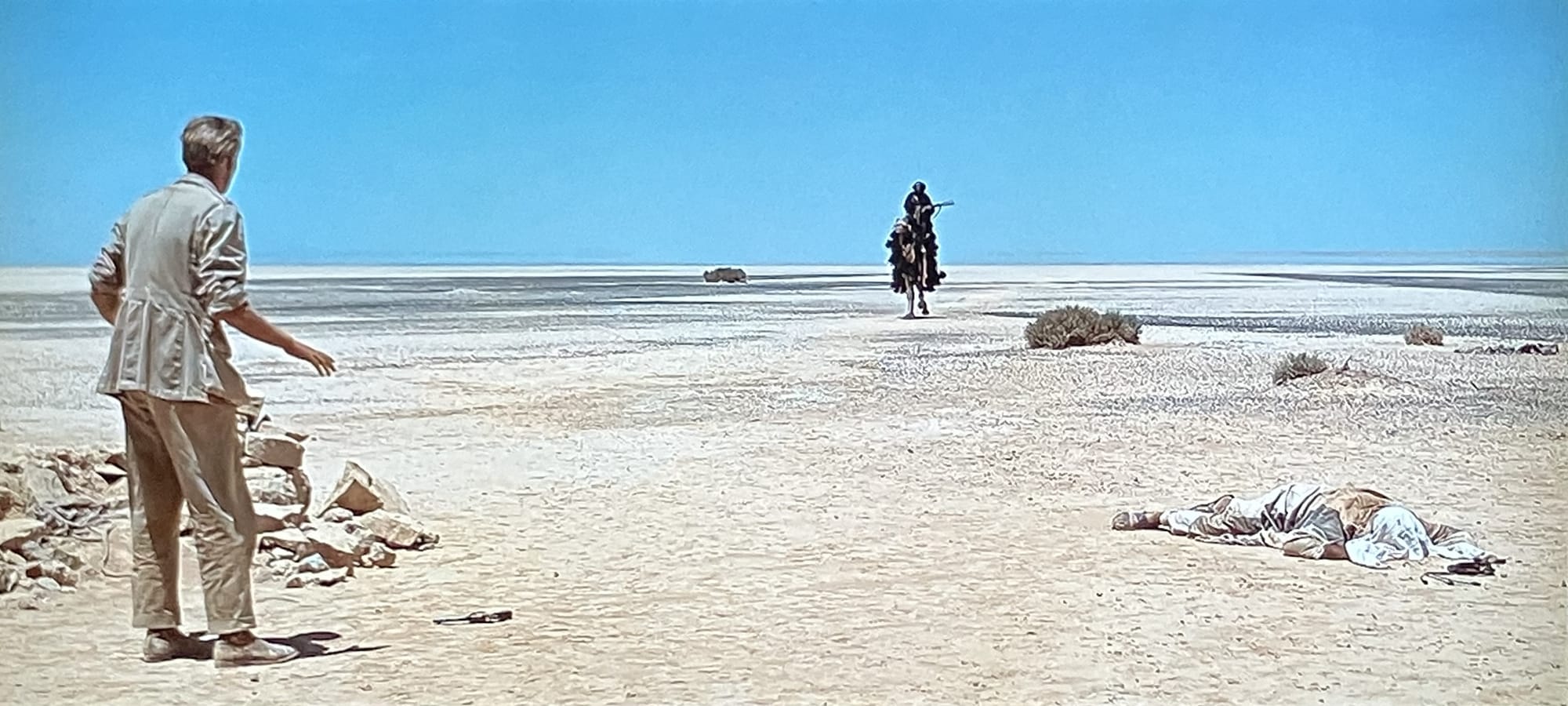
Except love. Leave aside the near total absence of women in Lawrence of Arabia, noteworthy even for a war epic. O’Toole’s Lawrence is utterly unavailable. If there is a romance in the film, it occurs between Lawrence and his Arab counterpart Sherif Ali, played by Omar Sharif. But how one-sided it is. Their first encounter begins with Sherif Ali shooting Lawrence’s guide, and the following exchange:
Sherif Ali: What is your name?
Lawrence: My name is for my friends.
Their friendship ends with - let’s just say a painful parting. Lawrence wants to be a god, explicitly at times. Failing that, he yet holds on to the rule that, to borrow Updike’s line, gods don’t answer letters.
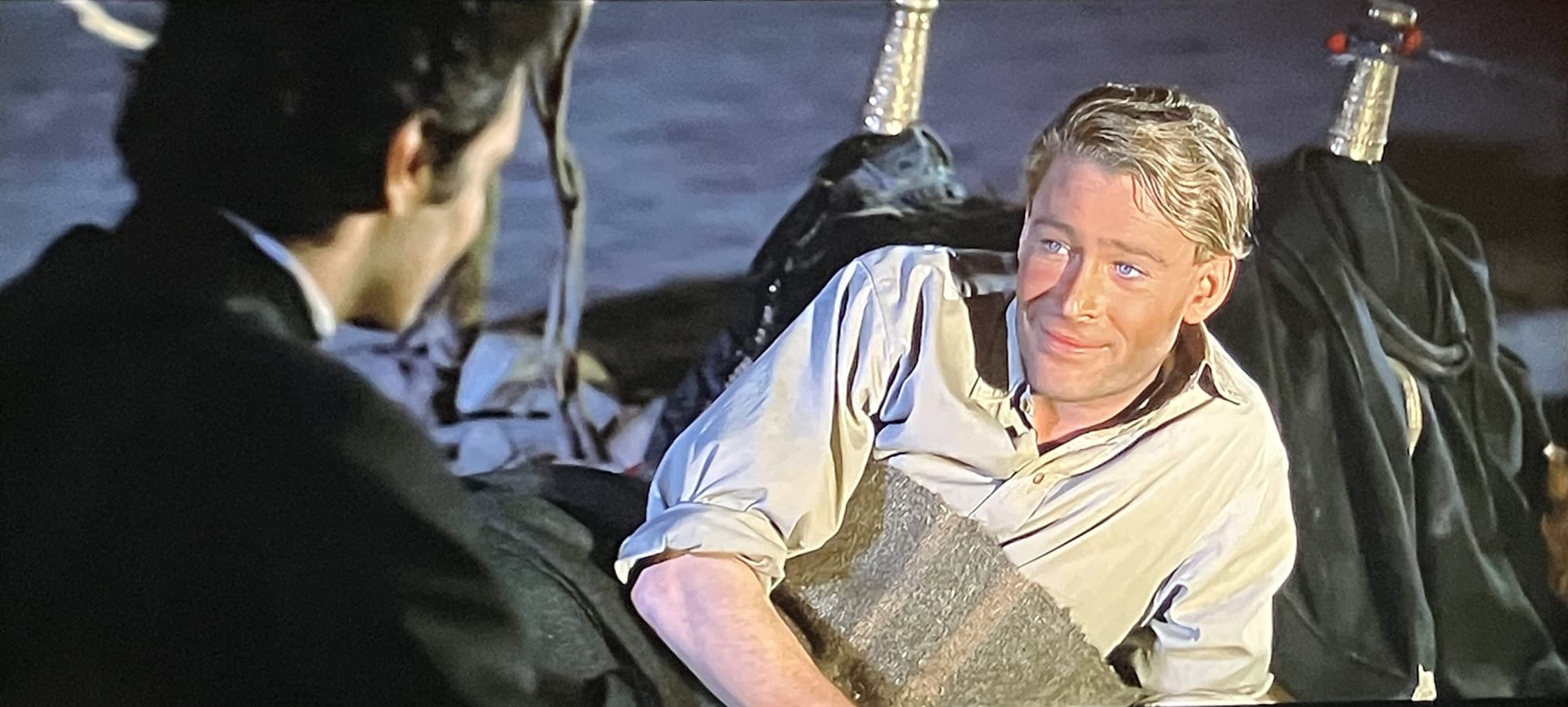
And, too, the boys who become Lawrence’s servants. They are, just as the real Lawrence, of parentage that assigns them to a lesser class. (They are also, to a degree, an invention - Lawrence apparently had one servant, not two, and that young man’s fate was different from that of the boys in the film.) From the first moment, Lawrence adores them, even despite the easy way he treats them as underlings.
There was some controversy about the real Lawrence’s relationship with his servant; a 1999 article in National Geographic notes:
The intensity of their friendship raised eyebrows at Carchemish [where Lawrence engaged in an archeological dig prior to the War], especially after Lawrence, who loved to shock, refused to dispel rumors of a physical relationship. Many at Carchemish, including Lawrence’s colleague Leonard Woolley, later dismissed these stories as nonsense. Like every other known relationship in Lawrence’s life, this bond with Dahoum was almost certainly platonic.
That dismissive “almost certainly” seems a bit too certain, to my mind, as if eager to exempt Lawrence of this one particular stain on his character. From the standpoint of the film - of my experience of the film - I find it both interesting and irrelevant. More revealing is that only in the role of father, of a kind of god the father, does Lawrence allow himself to express love, and experience all the pain that that emotion can carry.
Every time I see it, I think I know Lawrence of Arabia, but you cannot step into the same desert twice. I’ve just returned from Mexico, as smitten with that land and people as the young T.E. Lawrence riding in awkwardly on his camel. So I watched with greater attention, doubtfully, as he pledged his loyalty to his new companions, as Prince Feisal, played by Alec Guinness (1), asked him, “You are an Englishman. Are you not loyal to England?”
Lawrence: To England - and to other things.
Feisal: To England and Arabia both? And is that possible?
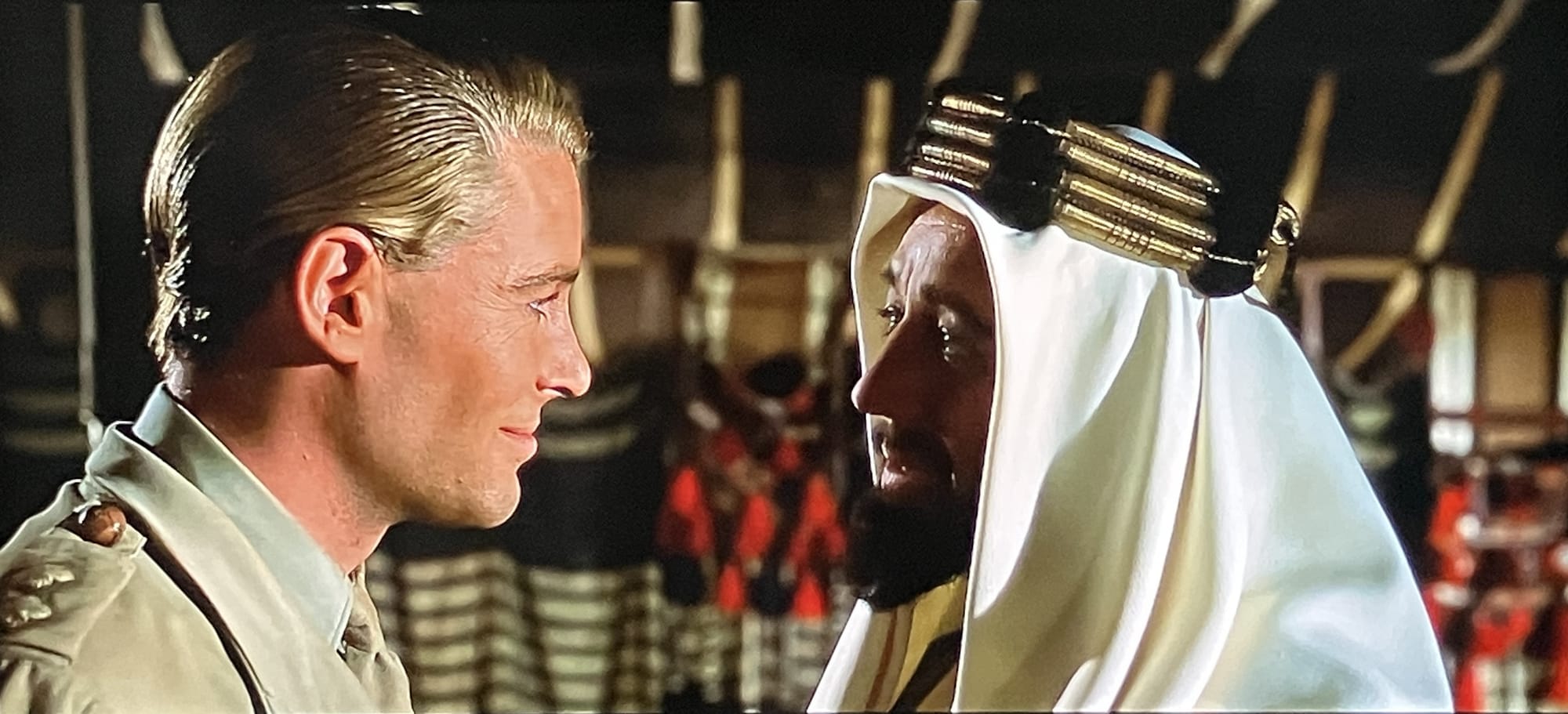
Is it? Not easily. It was an abstract question to me, once.
And every time I see it, I want Lawrence of Arabia to end at the intermission, just before the intermission, at the moment when Lawrence arrives in Cairo to tell the general that he and his Arab army have reached Aqaba. A less courageous film would grant my wishes, I think, fading to black as Lawrence strides into the officers’ club, congratulations cascading upon him from all sides.
Lawrence, though, is a tragic figure from the start. The world, in Feisal’s words, displaces the virtues of young men with the vices of older ones. Lawrence imagines the desert to be clean, but he arrives there in the midst of war, and by film’s end it consumes him. In its second act, Lawrence of Arabia achieves the impossible: It bleeds all the romance out of a war epic, and reveals war to be barbarous and pointless.
Nearly thirty years ago Janet Maslin sent me to the Paris, where I found a film worthy of the answer to the question, “What is your favorite movie?” A few years back the cinema reopened under the ownership of Netflix, and whatever that company’s faults, they’ve assembled a crew that cares about movies - films, but equally movies. Each year they have a series called “Big and Loud,” and each year they bless New York with showings of Lawrence of Arabia, remastered, on the sort of screen it deserves, with sound to match. You will find me in the balcony tomorrow, and maybe again after that, sinking into my seat and smiling along with Peter O’Toole as that beautiful overture swells.
I write about art and what makes it meaningful. Subscribe to receive these posts in your mailbox.
(1) Problematically, without question, but that’s for another day.