my joy of baseball
Everybody was a Reds fan, and everybody played little league, but that's not how I fell in love with baseball.
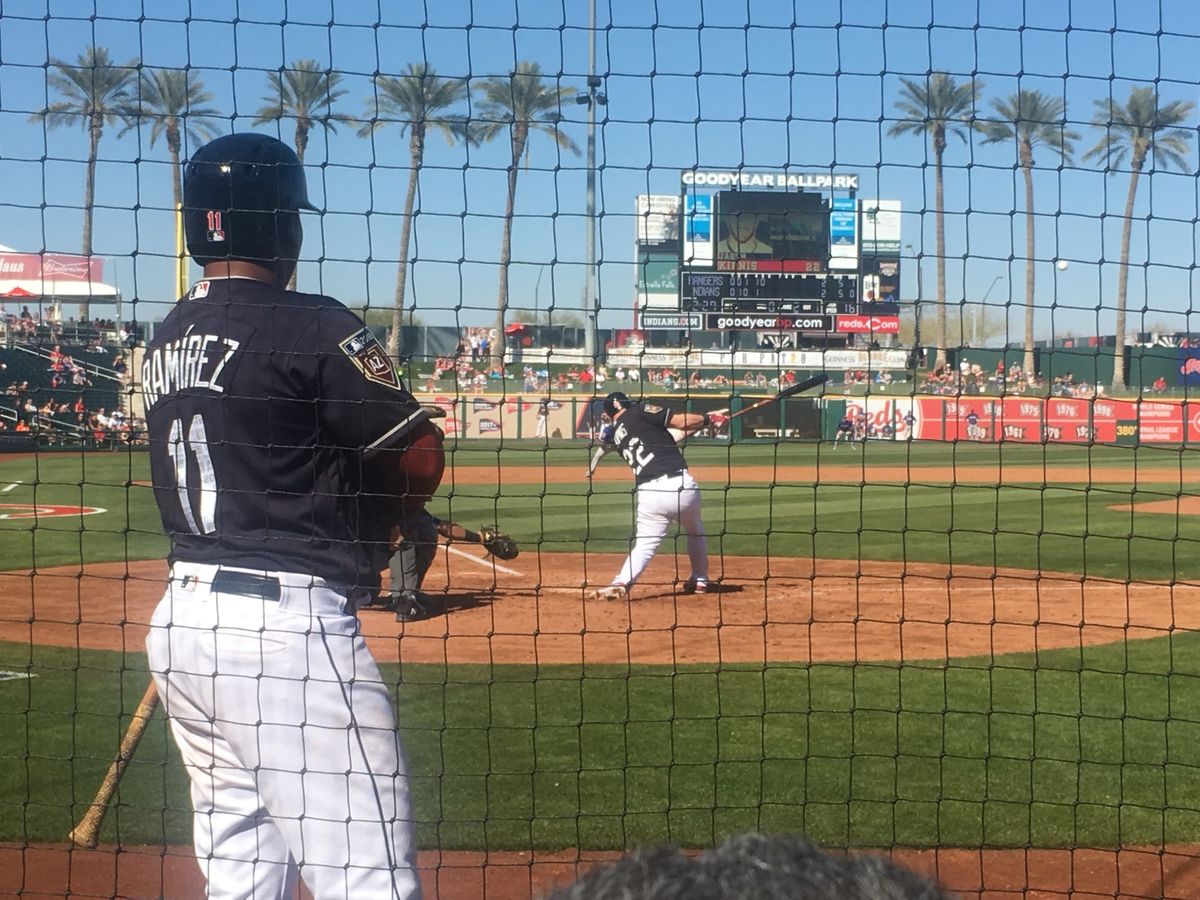
Everybody was a Reds fan. It was the water. In little league, we imitated Joe Morgan at the plate flapping his left arm like a chicken wing. We tried to dive into third base headfirst like Pete Rose, but our coaches stopped us: “You'll break your neck,” they said. We could recite the lineup and ponder how many were going to the Hall of Fame. Six or seven of eight didn’t seem out of the realm of possibility.
My dad drove my brother and me the two hours to Cincinnati to see them in their huge new stadium - I was young enough that I was more captivated by the animated scoreboard than the action on the field. A couple years later we stayed up late and watched them beat the Red Sox in seven games, and then dismantle the Yankees the following season. And then we cursed the Dodgers who were on their own ascendancy.
Everybody was a Reds fan, but that's not how I became a baseball fan.
Everybody played little league. In the 1970s, Kilbourne, Ohio, was the sort of place where they came through the second grade classroom to sign kids up, and practically every boy did. So I did. I was never any good, but they found a space for me in the outfield and at the bottom of the lineup, because it was a small town and because I kept showing up. I don’t know whether I ever enjoyed it. I can tell you I hated the pressure of standing at bat, alone, parents and teammates watching. I wasn’t a huge fan of having the ball hit to me, either. I guess I got over some of that, because I stuck it out through high school ball, where they still sent me to the outfield, if they had to, and where my most significant contributions were keeping score and stealing the other teams’ signs.
I liked being on the team. I liked the camaraderie. I liked catching batting practice, which let me be involved on every pitch. I was determined, even if I couldn’t defeat baseball, not to let it beat me. The perfection of the game, the way everything would square in a box score, the way you could analyze it and both understand it and never get to the bottom of it, appealed to the same part of me as advanced physics and English grammar. But it wasn’t playing ball that made me a baseball fan.
I fell in love with baseball on the radio.
I didn’t fit in as a kid. Maybe none of us did. The winners were the ones who didn’t care, who internalized and then externalized not caring what other people thought. I didn’t do that. I played baseball and other sports, seeking some measure of cred in the jockocracy of the Columbus Academy’s upper school. Unlike most of my teammates, I also did theater, which was uncool - “gay” was the adjective back then. At least in a play I could hide behind a character and a script. A lot of actors I’ve known are introverts, and I suspect they were drawn to acting for the same reason.
And in the evening, I would do my homework, or pretend to do my homework, listening to baseball.
The Reds first. There were local stations if I wanted, but often the better signal came from WLW, 700 on the AM dial, broadcasting from Cincinnati with 50,000 watts on the clear channel. The clear channel, for any kids reading, refers to a frequency that at night is dedicated to a single powerful station. Local stations could broadcast on those frequencies during the day, but had to end their broadcasts at sundown. It meant I could wander around the dial, and if atmospheric conditions were right pick up WGN from Chicago or KMOX in St. Louis or on a rare occasion listen to a voice speaking Spanish from the other side of the Rio Grande.
Or 3WE from Cleveland. The Indians’ broadcast team of Herb Score and Nev Chandler were less polished and more fun than the Reds’ team of Marty Brennaman and Joe Nuxhall. Herb was beloved for his malapropisms and misguided pronunciations and occasionally just being unintelligible. At the time I didn’t know that blunders constituted his signature style; I just thought it was funny and in some way more genuine than the Cincinnati guys. Nev couldn’t more have been Herb’s opposite: clever and sometimes sarcastic, a Northwestern grad who broke into wisecracks and impressions when the game lagged, as it often did with those Cleveland teams. They became my companions in the evening, or, in the summer when school was out, late into the night. I loved listening to a game from Oakland or Anaheim Stadium.
I didn’t fit in. Except with the game at the other end of the airwaves, whose nine innings encompassed a world that made sense.
I leaned into not fitting in. I abandoned the Reds - it became easier as the Big Red Machine was disassembled - and became the goofball wearing a Cleveland cap everywhere, bursting with optimism at the imagined future exploits of Von Hayes and Cory Snyder and especially Joe Charboneau, reciting RBI totals, carrying around books by Roger Angell and Bill James. I managed to find a few people who would put up with my obsession.
Being a baseball fan is weird. Weird in the sense of unpopular. People understand being a fan of basketball or football or fútbol. In Central Ohio where the state religion was and is Ohio State football, I was not quite so bold leaning into Cleveland Indians baseball that I could abandon the Buckeyes. But for the most part, the way I saw it, football was something you did when there wasn’t any baseball on the radio.
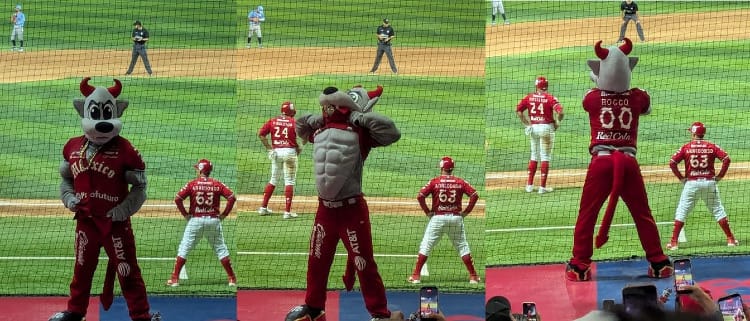
The way other people see it, baseball is that slow sport with long periods of nothing. In Mexico, where every pueblo has at least two things in common, the parish church and a soccer field, my friend Jorge repeatedly informed me that beisbol is not popular south of the Rio Bravo. He recently texted me to say he had finally gone to a game in Mexico City, home of the Diablos Rojos. “Beisbol still seems slow and boring, to me,” he wrote, although he acknowledged liking the atmosphere at the ballpark.
Even setting aside what other people think, the experience of being a baseball fan is strange. We wake up in the morning and debate whether to play Wordle before or after looking at the box scores, and it goes from there. If you’re a football fan there’s a chance that you can confine your fandom to one or two days a week. In baseball, the Baltimore Orioles’ manager Earl Weaver famously said, “we do this every day.” Fans and players both. It’s liberating; no matter how badly today went, you get a fresh start tomorrow. It’s oppressive: No matter how well today went, you have to go again tomorrow. Can’t I get a break from this? I have other things to do.
No, friend. This is what you signed up for.
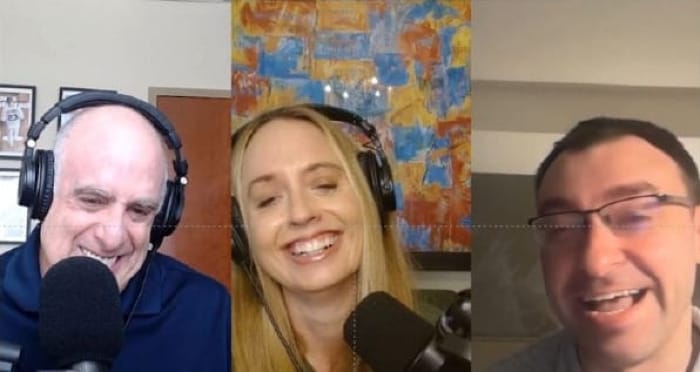
I’ve been listening to a podcast called “The Joy of Baseball.” Joe Posnanski and Molly Knight, two writers and journalists, launched it as an antidote to most of the news about baseball, which tends to be about labor strife, gambling scandals, and pitchers whose arms fell off because they tried to throw 105 mph, every pitch, every game. The body politic of baseball consumes itself with what is wrong with the sport. If a columnist is against deadline without a topic, “How to fix baseball” is readily available and sure to generate clicks and comments.
(This week’s news is the revolting way scammers treat kids in the Dominican Republic - and by kids I mean children, 11-year-olds - robbing them and their families out of signing bonuses worth hundreds of thousands of U.S. dollars, while Major League Baseball and its teams look the other way. It’s enough to make me question whether I want to write a post that includes the words “joy” and “baseball” in close proximity to each other.)
Molly and Joe spend an hour each week interviewing people about why they actually like this tortured, weird, often boring sport. If you’re a fan of baseball, the podcast is fun. If you’re not a fan of baseball, I think the idea is that you’re supposed to discover that baseball can be fun, although I can’t comment on whether that will happen. I have the sickness already.
Each week they begin by asking a guest why they became a baseball fan - how and when they fell in love with baseball. “Fell in love,” with all the implications of that state of mind, all the joy and comfort, and then for stretches the ennui and irritation. The optimism, the plans you make, the frustration, the heartbreak. The way, in Bart Giamatti's phrase which I quote often, it leaves you to face the fall alone. That is what you get from a longtime companion.
“The Joy of Baseball” works because every baseball fan has their origin story, the way every queer person, at least every one of a certain age, has their story about coming out. They’re all alike; they're all unique. Someone flirted with you, and you didn't know what to do, so you went home and sat on the kitchen floor and asked yourself if you were going to spend your entire life alone. Dad took you to Cincinnati and bought you a hot dog, and maybe ice cream in a little plastic helmet, and then everyone else was signing up for little league, so you did too.
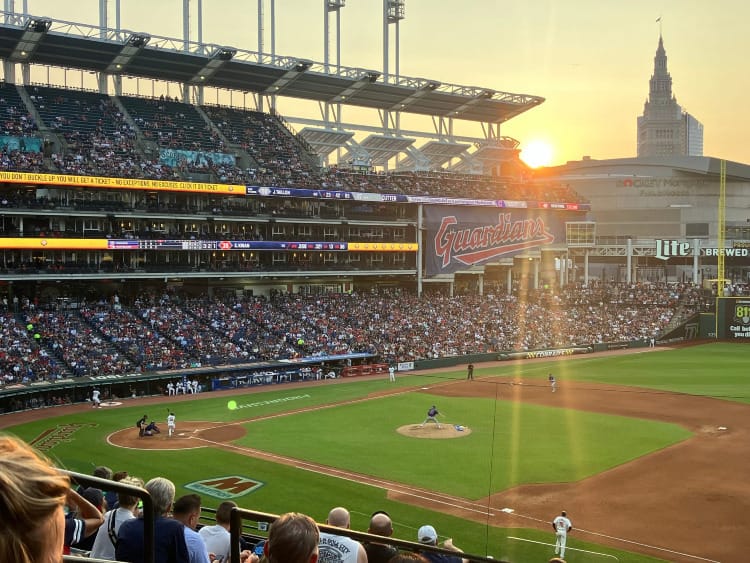
The next thing you know you’re sitting in a nearly empty Cleveland Stadium on a cold, early October night, legs thrown over the seat in front of you, watching the last game of a 100-loss season, players and coaches desperate to head off to more hospitable locales. Any locale would have been more hospitable than that 74,000 seat basement with winds off Lake Erie blowing hot dog wrappers around the field. But they played “Right Here, Right Now” on the loudspeakers between innings, and even then, for the few thousand of us in attendance, there was no place we would rather have been.
The BBC airs a radio program called Desert Island Discs. If you’ve never heard it, every week a guest is asked what eight recordings they would want to have with them if they found themselves marooned on a desert island. The program began during the second world war and continues to this day, which makes it the second-longest running radio program in history, after the Grand Ole Opry. When the original host Roy Plomley died in 1985, people debated whether Desert Island Discs could continue without him. This all happened shortly before I arrived in England for my junior year of college, and the professor who had accompanied my cohort from the United States started one class mocking the idea that a program with such a simple concept could have lasted for more than forty years, and moreover the idea that Britain could find no one else qualified to ask the question, “What eight records would you take with you to a desert island?”
Obviously, the show offers a bit more than that: It’s a celebrity interview show, like the ones hosted by Charlie Rose or Dick Cavett, that uses the jumping-off point of favorite pieces of music. A gimmick, if you like, but one that opens doors. At its best, “The Joy of Baseball” podcast operates this way, a conversation on the theme of baseball that is not about baseball at all.
But more importantly, our professor Terry, and we along with him, had made a basic error that travelers make, failing to understand the role of a cultural touchstone in the country we had arrived in. We failed to grasp how the steady presence of that simple show served as a reassuring harbor in the storm of modern life.
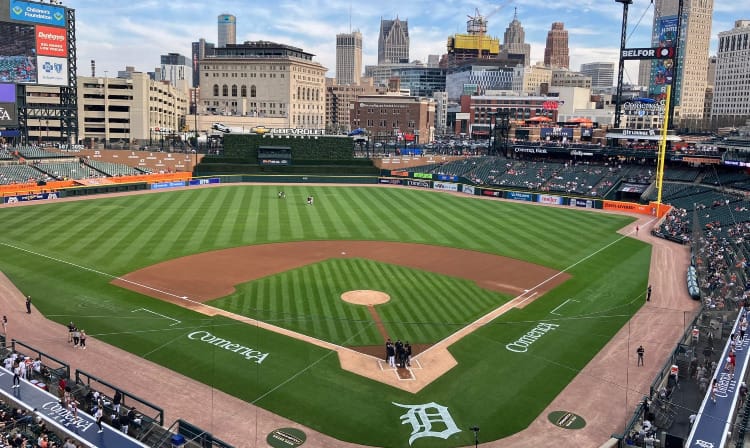
In the country of baseball, the managers and the umpires meet at home plate and exchange lineup cards and go over the ground rules, and the home team takes the field, and for two or three hours we will see the same events play out once again. The Detroit Tigers’ brilliant announcer Jason Benetti, in his appearance on “The Joy of Baseball,” talked about the challenge of keeping a broadcast interesting 162 times a year, while narrating one ground ball out after another. A valid concern, from his perspective. It’s an aspect of the game that will cause a newly arrived visitor to report that he found it slow and boring. Maybe Jorge is right; maybe it is.
But what Jorge didn't have with him is that whole cultural legacy, acquired one game at a time in places like Riverfront Stadium, whose shocking green astroturf I can still see, or Franklin County Stadium, where we stomped our feet demanding a moonshot from Steve “Bye-Bye” Balboni, or on the diamond cut out of a cornfield behind Brown Elementary School, or late at night in the dark of my dad’s den. The way my grandmother would have the Reds on TV and the Indians on the radio - two games at a time. And along with it, the whole history of the game, of guys whose last names aren’t needed: Babe, Jackie, Mickey, Willie, Rickey, Ichiro, Satchel. And the way the game’s history and your history come together, like on the day I read a short biography of Satchel Paige to my dad, and he said, “I saw Satchel Paige. My uncle Clifton took me and my cousins to Cleveland to watch him pitch.”
You go to the ballpark, and someone hits one of Jason Benetti’s routine grounders, and you remember the time a different batter hit another little roller up along first, and in that moment you’re exactly where you belong.
notes for nobody but myself is supported by readers like you. Please click the button to subscribe, and if you can, consider becoming a paying member.
(I should note that Molly Knight has become a friend, really through no fault of her own.)