the human element
Living Out Loud, Schrodinger's cat, and slot machines, and why they are like automated umpires.
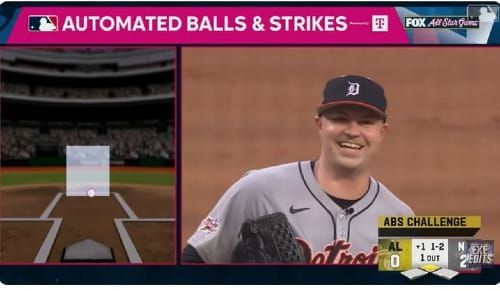
I am not going to go into the whole background of this, but Major League Baseball introduced this season a system to correct umpires’ decisions regarding balls and strikes this year. If you care about baseball you know the story, and if you don’t care about baseball you probably haven’t even made it this far.
I am here to tell you that the “Automated Ball-Strike” system, or ABS, as implemented, sucks.
This is a lonely opinion. People seem to like this ABS thing. They say it makes the games better, more fun, more fairly decided by players, not near-sighted umpires. Who am I to say they are not right? Well, I am me, and as I sometimes remind you, these are notes for nobody but myself.
There is a movie called Living Out Loud. You have probably seen it; it’s one of those movies that everyone has seen, and if you have, you may recall that Living Out Loud includes several scenes that are briefly surprising until you discover that they are actually just things the main character, played by Holly Hunter, has imagined doing. In the first of these she jumps from a rooftop after eating at a restaurant called La Goulue. It’s kind of fun, once, and then around the second or third time it happens, this way of tricking us into thinking something is happening which is not, becomes tiresome. You can’t invest emotionally in anything significant that happens in the movie, not in real time, because for all you know it's a gag.
Automated Balls and Strikes is like that.
Here's how it goes. A pitcher throws a pitch that a batter does not swing at. The umpire yells “ball” or “strike.” If it’s called a ball, the pitcher or catcher can say, we don't think so, and if it's called a strike the batter can say that - they can “challenge” the umpire's decision. Then some computer somewhere that's been capturing a million-billion data points translates that into a little video that they show on the scoreboard and on TV, accompanied by an ad for a phone company, and you learn whether what you just saw was what you just saw.
Someone somewhere knows the number of pitches that nobody swings at in a game. I’m going to guess it’s between 100 and 150 - 50 to 75 a side, or about half the pitches in the game. For half of the game, you watch what you see, the umpire calls a ball or a strike, and then, except in a few obvious cases where the pitcher heaved the ball to the backstop, you wait to see whether what you saw was actually what you saw, or whether there’s going to be a challenge. So you have to delay your reaction, your investment in the action of the game, by a few seconds.
The important point here is: not just in the relatively few times a game - perhaps a dozen, often less - that someone actually challenges what the umpire said. After every pitch that is not swung at, except the few obvious cases, you wait a second or so to see whether the batter or catcher (1) is going to tap his head - that’s the signal that means, “I’m going to challenge you, Mr. Umpire.” For two seconds, baseball enters a Schrödinger’s Cat zone where the action has happened and it has also not happened, until someone opens the challenge box and we find out. (Or they don’t open it, and the umpire is assumed to be right, whether he was actually right or not.)
I guess there is some fun in that, if you are the sort of person who likes watching movies where you don’t know if what you just saw has any relevance to the plot, or if it’s just some internal character dialogue that the screenwriter was too ineffective to handle any other way. Many people liked and still like Living Out Loud. Roger Ebert gave it 3-1/2 stars. (He did not mention the imaginary scenes, which seems like an oversight.) For my money, I prefer to be able to cheer or boo action as it happens, and not hold my emotional response in reserve while I wait to find out if we’re going to open the box.
It’s even worse if the batter or catcher actually does challenge the umpire’s decision, because now you have to wait for the computer to turn its million-billion data points into an animation. So we get an announcement from the umpire, and then they show the animation, which shows a little animated baseball coming out of the air (there’s no animated pitcher) above an animated mound, toward an animated gray box representing the strike zone, and then the strike zone turns the trademarked color of the phone company as the announcer says the phone company’s name, and we find out whether the cat is alive or dead, and then everybody cheers or boos something that happened ten seconds earlier. (2)
People will tell you that crowds at the ballpark love seeing the automated ball/strike challenge automation, that they sit on the edge of their seats and react wildly to the outcome. I believe that. You know what else people like? Slot machines. And this whole animation thing feels very much like a slot machine to me. You put a quarter in (actually, these days, you tap a card against a card reader), and some wheels turn (these days, animated wheels), and after five or ten seconds you see the outcome which was actually decided the moment you tapped your card. The computer with its million-billion data points knew whether it was a ball or strike before the umpire even said anything. The animation is just some nonsense to put on the scoreboard to display another ad and to make the athletic sport of baseball into a different thing that looks more familiar to generations younger than I.
Again, many people like this. For my part, I like liking sports to be about liking sports and not about liking gambling.
So let’s talk about gambling. Baseball has in the past decade gone whole-horsehide into the gambling business. Again, I'm not going to give the backstory, you either know it or you don’t care, but every broadcast is jammed full of ads for online casinos, even more than it is jammed full of ads for phone companies. You can bet on pitches, on what individual batters will do, on what combinations of batters will do, on how many foul balls will be tossed out of play, all of it. The broadcasts show odds of events happening with every pitch - the likelihood of a strikeout, of a double play, of a home run. Some of this is accompanied by an overt ad; other stuff, like the odds on every pitch, is not, but is presumably put there because a gambling company paid the broadcaster to normalize setting odds on everything.
It goes deep, this effort to scrape up every gambling nickel Major League Baseball and its gambling friends can scrape. A player for the Kansas City Royals in the last week was scratched from the lineup because of an infraction of some sort. It should have been nothing, the sort of thing that happens all the time. It became something because now lineups are released earlier than they used to be, and the media noticed that the player was first in the lineup and then not in the lineup. The lineups are released earlier than they used to be to help the casinos set odds.
Automated Balls and Strikes, as currently implemented, pushes things just a bit further in that direction. It puts a layer between the action of the game and the experience of the game, in the way that a wager on the outcome of an at-bat makes the spectator’s reaction not about winning or losing the game, but winning or losing the bet.
Betting on sports and getting umpires’ calls correct are different things, of course. And yet, in their incarnation, they are having the same effect.
I will now acknowledge that mostly, I don’t care about missed calls. I’ve liked baseball for a long time, and there have been a lot of missed calls in that long time. They generally sucked, but that was part of the deal.
There are still missed calls; somehow in the last couple weeks the umpires decided, well after the play, after the Dodgers had complained, that a batted ball had hit Cleveland’s Angel Martinez in the batters’ box, as if their memories of the moment were better than when they had actually seen it live. The reversal of the initial decision didn’t help the Guardians’ chances, and it annoyed me that it might have been a blown call. (3) And then I reminded myself that the key is not to care about these things too much.
Of course, if you’ve wagered an amount of money and the outcome hinges on a particular call, ball or strike, safe or out, fair or foul - in that case, you care about things more. And Major League Baseball needs to make people feel that they will win or lose fairly, in the service of keeping its benefactors in Vegas happy.
I don’t bet on sports; I do my best not to bet on anything, because there is no reason to believe I am not just as susceptible to the devices and algorithms that the gambling companies want to confront me with. The way not to end up at the bitter end of that road is not to start down it at all. Because I don’t bet on sports, I have the - let's say “luxury” - of caring less about outcomes. About championships, in truth, but more about individual games, and certainly about events within a game. If I find myself getting worked up, I try to remind myself of this, and turn the damn thing off and touch grass.
The mentality behind insisting on the accuracy of all balls and strikes, of insisting that every call be correct, certainly serves the interests of the teams and leagues. It underlines the idea that Sports Matters, when by any rational analysis it does not. Getting all the calls right may make the game better. It does not therefore stand that it makes life better.
Again-again: you may not be like me, I don’t know.
When I mentioned I had a rant in me about ABS, a friend cautioned me about going back to the tired old saw of “the human element.” I am not particularly concerned about the human element in the sense of preserving a wall that prevents robots from entering the playing field. I do think we would be better off, however, to preserve the elements of the game that support our humanity, and to avoid introducing elements that do not.
All of that said: If you’re going down the road of trying to get more calls right, there are better ways to do it than what Major League Baseball has decided on.
One way is to eliminate human umpires from the equation entirely and use the computers and their data points for every pitch. This is already done in Korea, apparently, and the technology obviously exists to do it. (In fact, the Korean technology seems to be better than that used in Major League Baseball; in Korea they have a system that recognizes that the strike zone is supposed to be three dimensional, whereas in MLB, ABS uses a simpler two-dimensional plane.)
Once you assume that the computer is infallible - it is not - there’s really no defense for not using it on every pitch. Major League Baseball did not do that, I would assume, in part because they would find themselves in a fight with the umpires’ union, and in part because it’s easier to cook the old-school frogs like me by turning up the ABS water gradually, rather than dropping us into a boiling pot.
In any case, almost everyone agrees that full-on, 100 percent ABS is inevitable, and probably by the next time the umpires’ contract comes up for renegotiation.
The other way - in my view, the better way - would be to acknowledge that the computer is not infallible, as well as that both the actual challenges and the moments of wondering whether a challenge might happen are detrimental to the experience of the game, and have a buffer that says, “close enough.”
The idea would be this: If the computer determined that a pitch was within a certain distance of the edge of the strike zone - an inch, or half an inch, say - whatever the umpire said would be correct. If the pitch was in the strike zone and the umpire called it a ball, but it was within that buffer, it would stand as a ball. If the pitch was out of the zone but within the buffer, and the umpire called it a strike, then a strike it would remain.
From one way of looking at it, this seems silly. If you assume the computer is infallible - again, it is not, but that is the assumption being made - then what justification is there for taking the umpire’s word against the machine? And this is what Major League Baseball, and particularly its commissioner Rob Manfred, concluded: the computer is always right.
That is the conclusion a lawyer would come to, and Rob Manfred is a lawyer. The conclusion that a human who loves baseball would come to - it is not clear that Rob Manfred is either of these things - is that the buffer zone would better preserve the experience of the game.
Here’s the thing: Pitchers are really, really good at putting baseballs in that buffer zone. The sportswriter Joe Posnanski (4) has put together a series of posts that make this clear. Pitchers almost never intentionally throw the ball over the middle of the plate; when they do, those baseballs tend to travel a long, long way. Pitchers live on the edge of the strike zone, or they do not last in baseball.
Also, batters tend not to swing at those pitches, because they’re hard to hit. Better to wait for the next one and see if the pitcher makes a mistake.
What this means is, the vast majority of pitches that batters don’t swing at are potentially subject to challenge. In other words, most are pitches where you and I (5), watching the game, wait that two seconds to see if the batter or catcher is going to challenge it.
And, it’s not at all clear whether the accuracy of calling such pitches balls or strikes makes much difference in the outcome of a game. Yes, there are moments when a walk becomes a strikeout, but generally speaking, it seems that:
1) Umpires get challenged calls right about 50 percent of the time, and
2) They favor the pitcher or hitter about 50-50.
In the scheme of things, it doesn’t seem like computerizing ball-strike decisions on those pitches makes much of a difference at all, over the course of a 162-game season. (6) So for minimal benefit, or no benefit, the lords of baseball have dramatically (in my opinion) changed the experience of watching baseball. And (in my opinion), not for the better.
Far more important is to focus on the egregiously wrong calls, the ones outside that buffer zone that fans in the stadium, and certainly everyone watching on TV, can see are simply wrong. Not by a tenth of an inch, but by half a foot. Those terribly wrong decisions are rare - umpires are really good at their job! - and so offering catchers and batters the opportunity to correct them likewise has minimal impact on the flow and the feeling of the game. In fact, one could say it improves the flow and feeling, because now we - and the players - are not feeling peeved about being wronged badly, and now the manager is not running out of the dugout to argue with the umpire or to keep his batter from being ejected.
Those calls are worth fixing, and they could easily be fixed while letting baseball still feel like baseball. If that’s what you want, of course. It’s not obvious whether that’s what Rob Manfred wants.
Well. I have reached the truly irrelevant part of the post, the ship-has-sailed part.
ABS with its infallible computer is here, and it’s here to stay. Maybe you like it that way. My notes and I will continue to be borne back into the past, yelling at clouds all the way.
(1) It’s almost never the pitcher, because the pitcher is falling off the mound and can’t see what happened.
(2) Really, it would be more dramatic to put a box on the screen that opens to show that it has either a live or a dead cat in it.
(3) Replay, which the umpires did not and under the rules were not allowed to review, suggested they got it right. I feel certain that was nothing more than a lucky guess, given the way events had played out.
(4) Joe has spent way more time on this than me, and you should probably pay more attention to him.
(5) Within my readership, probably just me.
(6) People who know more about statistics than I do are arguing about this point, but at a minimum it seems debatable whether mistaken calls on borderline pitches affect things.