thinking in spanish (dispatch 11)
An instructor asked me a while back if I had started dreaming in Spanish. They say that happens. The new language gets deep enough in your brain that it enters your subconscious. I had never thought about whether I dream in English, and all of a sudden I’m trying to identify the language of my dreams and not just puzzle out the bizarre and convoluted images.
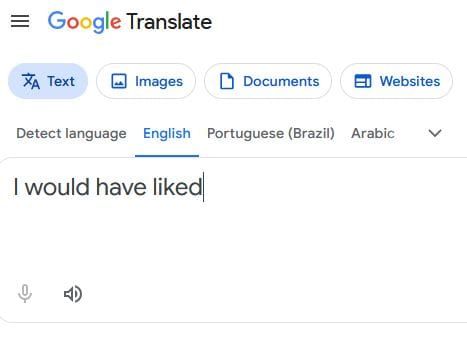
When you’re learning a language, they always tell you not to think in English and translate - you have to think in the new language. Invariably, forming a sentence in English and going word-by-word, you march yourself right into an idiomatic trap and have to start over. I do that less, but still more than I’d like. Or I’ll suddenly realize I’m heading toward the past perfect conditional and speaking becomes a form of higher calculus. Someday, maybe, saying “I would have liked to have done that” will be as automatic as se me olvidó. But not today.
I don’t know how much I think in Spanish, because the minute I think about it, I enter some part of my brain that prevents me from being able to tell. It’s the Heisenberg Linguistic Uncertainty Principle; as soon as you pay attention to it, you change what you’re trying to observe. I can say I definitely have moments, even days, when I can’t think in Spanish at all. On the other side, I have moments when I realize I’ve been chatting away without thinking about what language we’ve been speaking. But, again, that means I haven’t been paying attention to what my brain has been doing.
Variations of this lurk around every corner, living in a new country. I struggle to think in pesos. I can manage familiar stuff, the purchases that are like Que tenga un buen día, where even though it’s the maldito subjunctive it just rolls off your tongue. Twelve pesos for a liter of water is pretty good. Buying a handcraft at the market? Let me open the calculator on my phone. (It was easier, not to mention better for my wallet, when the exchange rate was 20 pesos to the dollar. Dividing by 17 is not something we spent time on in school.)
And yes, liters and half-liters are easy enough on their own. Kilometers I can manage, más o menos; we used to have road signs listing the number of kilometers to Cleveland. Centimeters, especially in quantities more than about five, are more problematic. Back at the hospital, they record weight in kilograms, and my calculator comes out again. 79 kilograms - is that good? I’m down about two kg since I first got here, which will make Dr. Mizrahi happy. Except that I will probably revert to the norm as soon as I’m not hiking up and down Cuernavaca’s hills.
At the super I’m back in Larry Booth’s Calculus II class. Butter is measured in milligrams. (Who other than pharmacists measures anything in milligrams?) So I convert that, approximately, to ounces, but then it’s still priced in pesos, so I have to do that conversion as well. And do this for each of a dozen unfamiliar brands. And then it’s off to canned goods, where quantities are measured in milliliters. (1)
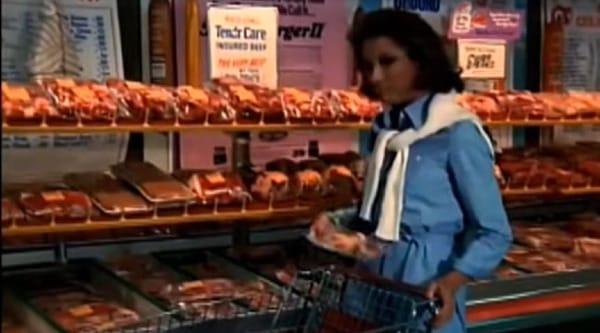
All this stuff is supposed to become automatic. None of it will be automatic as long as I keep doing the math of converting to feet and gallons and pounds and dollars. Someday I’ll be able to evaluate the price in pesos of beef measured in kilos without stopping to math it out. Until then, I’m just Mary Tyler Moore shrugging and tossing the package into the cart.
In Mexico City on Sunday I went to a play. I joked that it was my latest Spanish test, but I wasn’t entirely kidding: I wanted to see what I could do.
I suspect we have all had that feeling of looking at the first two or three questions on an exam and realizing we’re in trouble.
The play itself, Marina Carr’s Girl on an Altar (La niña en el altar), didn’t make my task any easier than one of Mr. Booth’s calculus tests. It tells the story of Clytemnestra and Agamemnon during the Trojan War (the story is here, in case your memory of Ancient Civ class is not any better than mine). I’m sure it’s a wonderful piece, but the poetry of its soliloquies - and it’s full of soliloquies - was lost on me as I struggled to comprehend what I was hearing, word by word. Again, not what you’re supposed to do whether making the ida or the vuelta, English to Spanish or back. Sometimes I figured it out. Sometimes I saw Agamemnon climb up on his platform and thought, here comes another one, and closed my eyes for a moment.
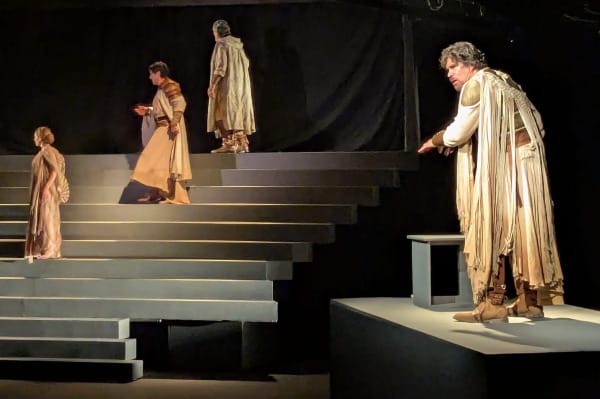
I suppose it was a good production. The audience shouted a lot of bravos at the end, and some of them stood. I wasn’t sure whether that was genuine or whether it was the public congratulating themselves for their good taste, as so often seems to happen. In a theater in the United States I would have assumed the latter - the audience stood to applaud the performance of Xanadu that I saw, for heaven’s sake - but ovations are perhaps another aspect of living abroad where I lack cultural competency.
For that matter, so is acting. I’ve seen a lot of actors up close; spent enough time thinking and talking (and writing) about theater that I have an instinctive, if personal, sense of what is a true and powerful performance and what’s not. That question is undoubtedly, enormously cultural. I have seen two plays in Mexico and in terms of understanding performance have not progressed much beyond buenos días.
From my biased perspective, the emotional pitch of La nina en el altar started at around a 9.2, and when you start there it doesn’t give an actor much space to build. It was shouty. Which, candidly, did not help my comprehension. But I make no pretense that my judgments represent anything more than preference born of sixty years of being trained by the culture and expectations of theater in the United States.
Except this: In the second act, Salvador Sanchez made his appearance as Tyndareus, king of Sparta and father of Clytemnestra. I mean no slight to the other members of the cast when I single him out for lighting up the stage. You’ve rarely seen such an effortless performance. It takes a lot of work and skill to look effortless.
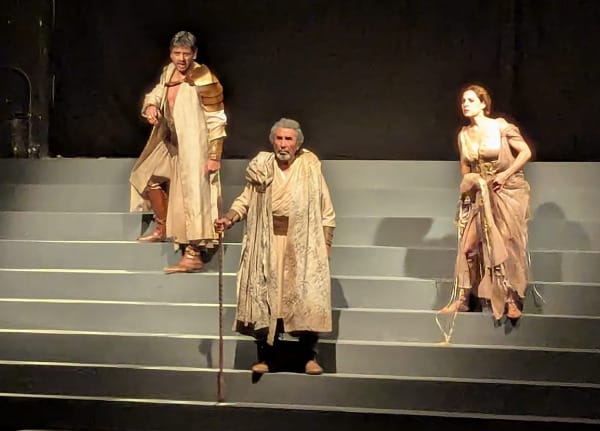
Maybe that’s the lesson. I spent a week in Mexico City hearing rocks tumbling out of my mouth. It’s (usually) not an effort to speak English; I could have gone on autopilot thinking about how Agamemnon’s costume got caught on the scenery without missing three lines of dialogue. It’s not quite always an effort to speak and understand Spanish, but rarely enough is it not an effort that those moments are a revelation: Wait, we were speaking Spanish!
And then I’m in the weeds again.
(1) A standard can of beer here is 473 ml, which seemed odd until I plugged it into a conversion calculator and found that that’s 15.994 ounces. It’s easier for AB InBev to use Imperial-sized cans, I guess.
Biased as I am by my upbringing and education, I hold fast to the belief that imperial measures are superior for life as it is lived. 100 degrees is about as hot as it gets (or was, when I was a kid); zero degrees is about as cold. Twelve inches to a foot is easily divisible into halves, thirds, or fourths; way better than a hundred centimeters to a meter. Kilograms feel ungainly large as a measure; centimeters unreasonably short. Acres, I will grant you, are stupid.