what i didn’t write (dispatch 14)
Some things I haven't written about while I have been in Mexico.

I’ve had many ideas for these dispatches during the last six months. Some of them got shoved aside for other more urgent questions. For others I just didn’t have enough to say, or more often realized I didn’t know enough to say anything worth anyone’s while.
Here’s what I haven’t written.
“America”
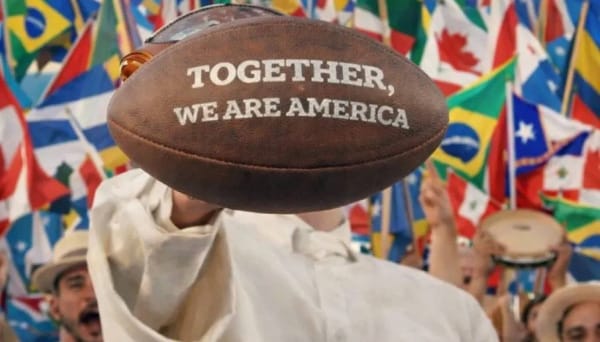
I was going to write this after Bad Bunny - “Ba Bony” here - celebrated the fullness of the Americas during halftime of the Super Bowl. (1)
A year and a half ago, when Paka and I were taking Spanish classes together in Cuernavaca, we were sitting at dinner with our host families. We were eating pozole to celebrate completing the week of lessons. Paka referred to someone, maybe themselves, maybe people in the United States generally, as “Americano.”
“What do you think about that word, ‘American’?” I asked the table, knowing full well the answer.
Every now and then I slip, but I’m pretty good about saying estadounidense here. After a bit of practice it started rolling off my tongue. Other people say norteamericanos to refer to US-ians, sometimes, but that always strikes me as overly inclusive. In any case, Mr. Bunny expressed a sense that Mexicans and others in the hemisphere would like to reclaim the words “America” and “American.”
English doesn’t offer good alternatives - “United States” works as the noun, but “US-ian” is every bit as clumsy as it sounded in the last paragraph. In order to make “American” inclusive we come up with another descriptor for ourselves. (2)
carros chicos
When I've traveled outside the United States, I am always struck by how small the cars are. We have some small cars in the United States, like the Smart cars I used to be able to rent for $0.14 a minute in New York City. But those are oddities.
Don’t get me wrong; folks are driving plenty of SUVs and full-size trucks here, too. It’s just that you can see a diversity of vehicles in Cuernavaca or Mexico City that I no longer see in the parking lot of a Meijer in Ohio.
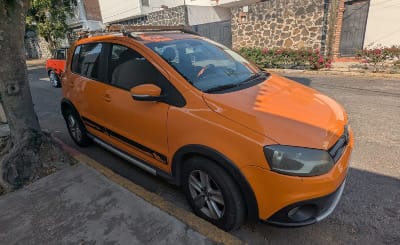
Here's a cute little four-door Volkswagen hatchback.
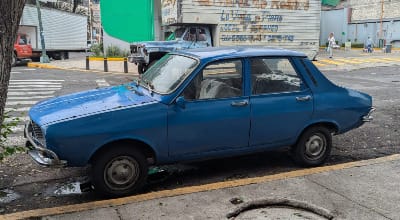
A combination of other factors - a climate that doesn’t demand road salt, economics, a mentality leaning toward repair generally - keep older cars on the road here. Especially, Volkswagen bugs. (3) Not an entirely great thing, given their exhaust. I like the look of this Renault, though.
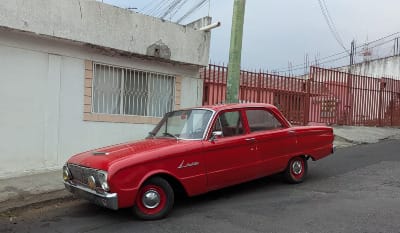
And here’s a Ford in somewhat better condition. Ford Motor Company has almost no current-day presence in Mexico that I can see, and I can’t imagine their decision to cancel electric vehicle production will to help. The Chinese automakers are going to eat the U.S. companies’ lunch here.
recorrido
Museums in Mexico, most that I have been to, have a recorrido. You enter here, follow through a series of rooms, and exit there. On occasion I have either failed to understand this or attempted to ignore it, and have been politely but firmly instructed by a guard, Señor, el recorrido se inicio aquí.
Museum curators, the museum culture, the nation approaches the task of laying out a museum with this ethos: We are telling you a story, and you will follow along. You do not start reading a history text on page 122, you start at the beginning. Likewise, you will start at the beginning of our argument.
Of course, you might flip to page 122 of a history text; maybe you want to know about Lázaro Cárdenas without slogging through Porfirio Díaz. You might miss some things that way; there might be nuances you miss, or important facts that you won’t understand. Then again, you might have limited time - we all have limited time - and you don’t want to have to wander through the masters of New Spain, poorly imitating Velásquez, to get to Clemente Orozco, busting new ground wide open.
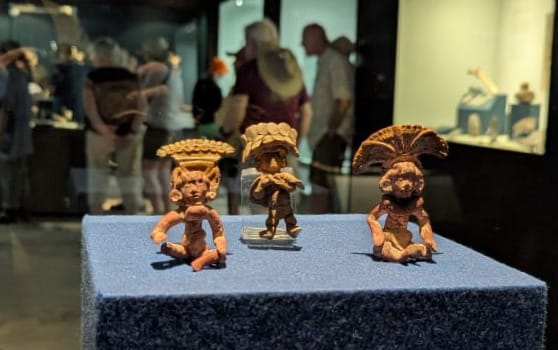
That, however, is not for you to say. The guard points you to the sign reading Entrada.
marcha
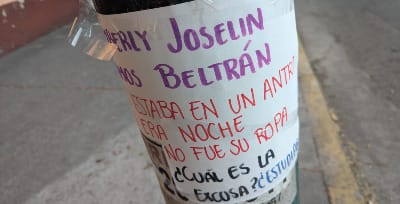
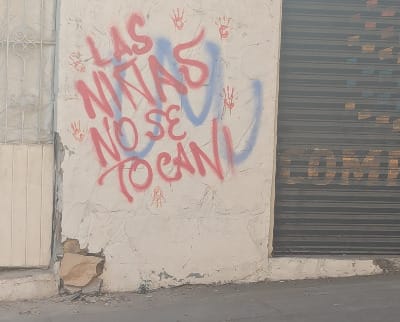
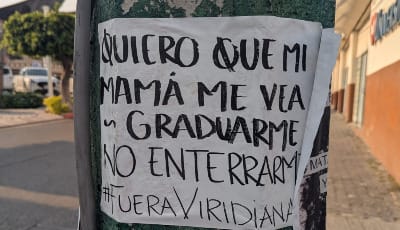
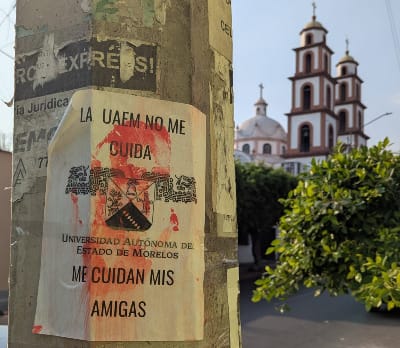
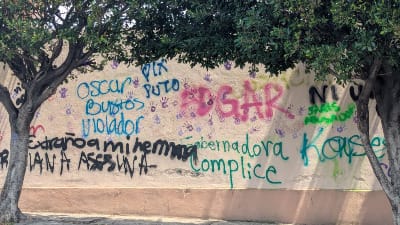
Near the start of the year, two young women who were students at the public university here, UAEM, were abducted and later found dead; a third was abducted and later found alive. The university responded by saying, in effect, “There’s no proof that anything happened on campus, so it's not our problem.”
The decision by the university not to take any action led to a student strike that lasted well over a month, closing the campus. A march from the university district to the Zócalo was announced. I had thought to go and document it, but friends advised against that idea. “Sera una marcha fuerte,” I was told. “You might be seen as a target.”
The marchers left angry evidence behind. Much remains visible on the buildings along Avenidas Emiliano Zapata and José María Morelos.
ihop
On my second day in Cuernavaca, when Jorge drove me to the supermercado, I was surprised to see an IHOP across the street. I asked him about it. “It’s new,” he said. “I don’t think the food is very good.” Well, duh, I did not say.
(Actually, I probably said something that amounted to that.)
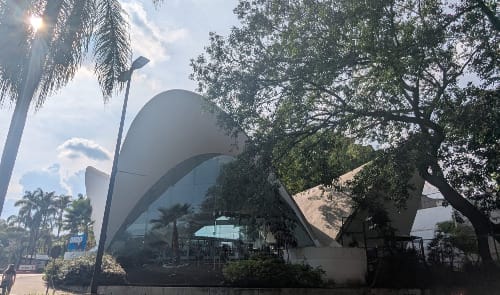
The unusual building consists of a set of intersecting parabolas that remind me of the wimple Sally Field wore in The Flying Nun. It’s a recreation of the dining room from Cuernavaca’s Casino de la Selva, which occupied the site of the IHOP and a nearby Costco and the súper that Jorge was bringing me to. It’s way too large to be an IHOP - it’s way too large to be any restaurant except at a museum or university where a thousand people all want to have lunch at the same time. (And Jorge told me that even UAEM doesn’t have a cafeteria that size.) (4)
A while later, after a visit to the hospital, I paid a visit. The IHOP is just around the corner and I’d had to fast before my appointment. The prices were stupidly high for Mexico, even taking advantage of an all-you-can-eat hotcakes promotion. Other than Spanish and pesos, the food and the experience were all exactly, bizarrely identical to what you would find at an IHOP in the United States.
banqueta
Accommodations for disabled people in public spaces are rare. Navigating the sidewalks of Cuernavaca is difficult enough for a fairly able-bodied person walking on his two feet. Walking up the hill to my apartment, suddenly fourteen-inch stairs present themselves in the middle of the block. Maybe I leap, maybe I throw a leg up, maybe I go around. Attempting it while wheels are involved?
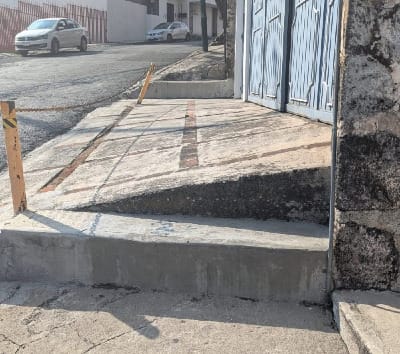
Once in a great while, if there is a sidewalk, and if there is a crosswalk, you might find a ramp for a wheelchair. More likely, neither sidewalk nor crosswalk exists, or possibly they do but there is no crossing signal. At only a few intersections in Cuernavaca will you find a stop sign or traffic light for the cars. Able bodied, you wait for a gap, cross halfway, wait for another gap. Using a mobility device?
So little in Mexico implies that a person who needs a walker or a wheelchair might exist, might need to go up this block - might want to, might have a right to do so. Even the parts of the hospital that I’ve visited lack accessibility. A ramp leads down to the clinic, but you have to go up three steps once you get to the door. As a consequence, I rarely see anyone using a walker or a wheelchair in public. Apart from the obvious benefits of opening the United States to people with discapacidades, one of the ways the Americans with Disabilities Act has improved life has been to demystify disabilities by making them visible.
A cafe here that employs people with cognitive disabilities has a wheelchair lift for the four or five steps up at the entrance. It seems likely that awareness of physical disabilities makes one sensitive to disabilities that are less visible, and vice versa.
“pueblo”
There are lots of ways to say “people” in Spanish: gente, personas, población, publico (specifically in the case of an audience), and so on.
There are various ways to describe a place where one lives: ciudad, aldea, villa, colonia, barrio, others I haven’t learned yet.
And then there’s pueblo.
I will be entirely candid: this is one of those topics where I don't know what I’m talking about. People use the word pueblo all the time, and I have to sleuth a little to figure out what they mean. Sometimes it seems to have a specific, possibly legal meaning, the way that “village” describes a particular type of place where I grew up in Ohio. People will say that Tepoztlán or Ocotopec or Anenecuilco or some other place is a pueblo. But also, people will refer to the twelve historic pueblos of Cuernavaca, which makes it seem like they’re just the older neighborhoods, once separate towns now fused by sprawl and administrative decisions.
And, it goes way beyond that, because la Presidenta will refer to the pueblo de Mexico, or say tengo un pueblo que me respalda in response to suggestions of foreign interference. “I have a” - what? Community? A people? A nation? All those things. Other times, Sheinbaum will say the authority of the government is derived from the pueblo.
Especially coming from the mouth of a politician, it has a slippery meaning, this word. This article notes that the dictionary of the Royal Spanish Academy lists five possibilities: a city or village; a small population; a group of people from one place; the common and humble people of a population; or the entirety of an independent country. It means all those things at once, or whichever your want it to mean. It’s a bit like when people refer to “the real America” - people like you, not people like them.
And, like the phrase “real America,” it harkens back to a version of the nation mostly lost to time, but not completely - incompletely enough to stand up those descendents, literal or philosophical, of Emiliano Zapata or Pancho Villa, as avatars of Mexican history and identity and authenticity.
full of grace
I went to a nearby pueblo called Jiutepec. My reasons for going there were mostly dumb. A craft market I had heard about turned out to disappoint. The Zócalo was uninspiring. The regular mercado was small and unappealing.
It had taken me a bit over an hour to get there, and I didn’t feel like going right back home. I chose a direction and walked. On a Sunday afternoon in March, Jiutepec was just about closed. All of the few bars and restaurants I passed that were open gave the clear impression that every inhabitant would stare at a stranger wandering in, let alone a gringo.
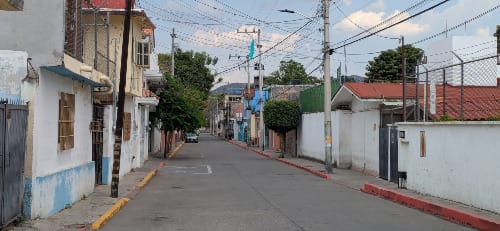
I walked two blocks west, two blocks south, two east, and turned back toward the Zócalo. I had seen a KFC on the ride to Jiutepec. The thought of its familiarity, and anonymity, appealed to me. On the block before the square I passed the church. Well, I thought, I may as well look. I entered through the side door.
Overdecorated, and then overdecorated again for Lent, without anything like a consistent theme that I could see anyway. One man knelt in a pew, about halfway back, praying. I walked around a little, but I didn’t want to disturb him, so I decided to sit for a few minutes. When I stood, he asked me, in English, where I was from. New York, I told him, but I’m living in Cuernavaca for six months.
“You are welcome in México, and you are welcome in God’s house,” he told me.
I thanked him. Then he invited me to pray the rosary with him.
“No soy católico,” I said. “I don’t know the rosary.”
He seemed puzzled by this response. I stood in the aisle for a moment. I said, “I’ll sit with you, and you pray.”
I sat next to him in the pew. He said, “Repeat after me.” We said the Hail Mary. Maybe a couple times. Then he handed me his rosary and said, “You say the first part, and I’ll say the second part.” We made our way through ten beads, then an “Our Father,” and then - I don’t remember how many we said. Not the whole rosary.
Let’s see what I can remember:
Hail Mary, full of grace
Blessed are thee among women, and blessed is the fruit of thy womb, Jesus.
Holy Mary, mother of God
... and something more about intervening on behalf of us sinners. Not too bad; he was saying the second part, after all. (4)
Ysrael and I went outside. His name was Ysrael. He wore a straw hat and a denim shirt and jeans, and we sat in the churchyard and he told me again I was welcome in Mexico. He played some Christian songs for me, modern ones, on his phone, and wrote down some important verses, and talked to me about the holy trinity. I told him that the idea of the Holy Spirit resonated with me.
We talked for thirty minutes or so, in the churchyard. He took my phone number, and then we said goodbye. Since it was Lent, I wondered if he might contact me at some point during the Semana Santa. I haven’t heard from him again.
I walked up a street until I found a place where I was sure the bus back to Cuernavaca would stop. The wait was long enough that I decided to skip KFC. The bus dropped me at the Plaza Cuernavaca, where I go to the cinema. I had wanted to see a movie whose Spanish title was Proyecto Fin del Mundo, and without thinking about it too much, I bought a ticket and the hot dog combo.
When the movie started I was reminded that the English title was Project Hail Mary. Make of that what you will.
(1) I’ve seen it written Súper Tazón in the newspapers. In my experience no living person has ever called it that.
(2) If I’ve used “America” or “American” to refer to the United States in these dispatches, it’s an old habit reasserting itself.
(3) The slang term in Mexico is Vocho, which I’m convinced is a play on the word bochorno, embarrassment. But friends tell me that’s not so.
(4) Should have been “Blessed are thou,” I guess, and yes, I know I left out the phrase “The Lord is with thee.”