green-wood
It is the ambition of the New Yorker to live upon Fifth Avenue, to take his airings in Central Park, and to sleep with his fathers in Green-Wood.
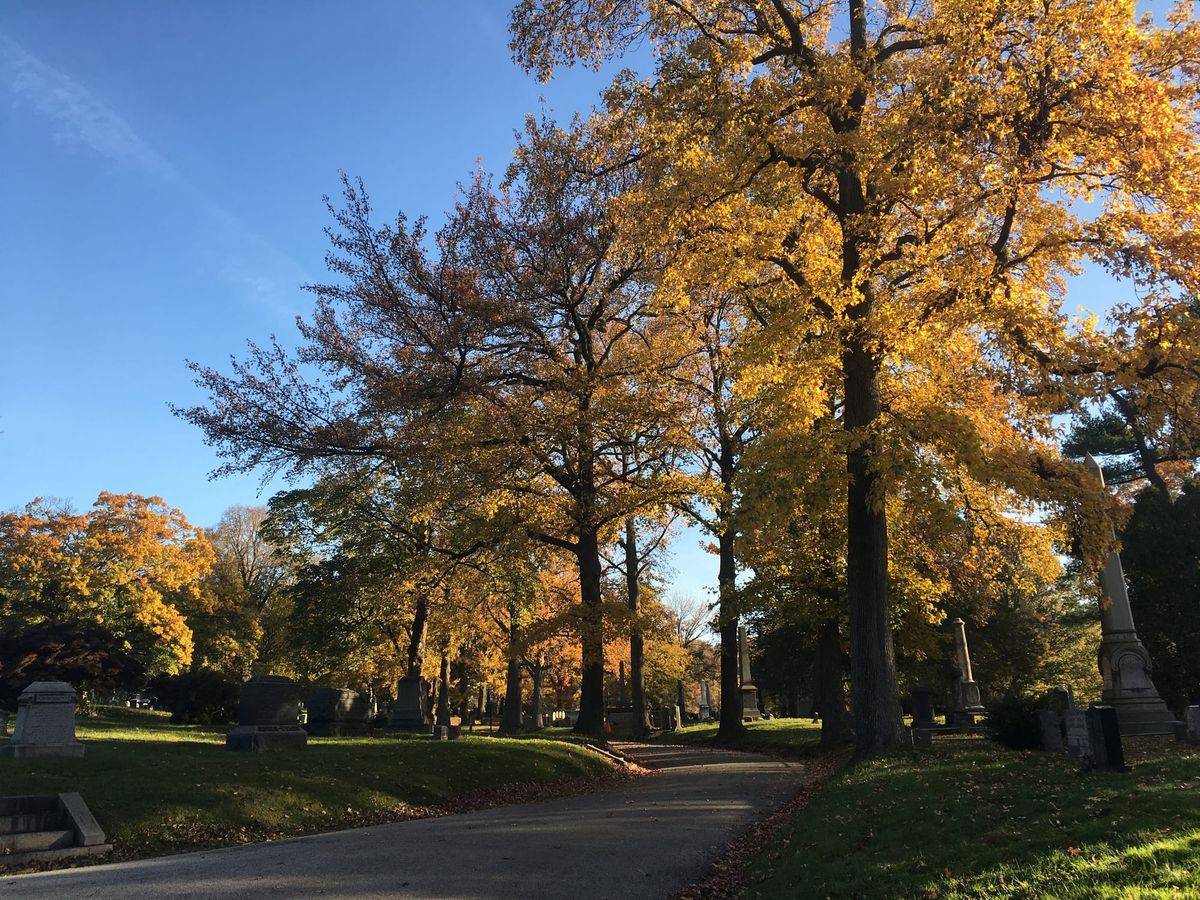
There is a whole story here.
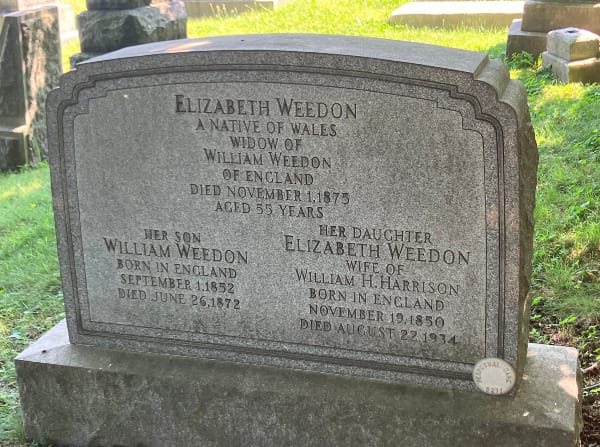
This is a tombstone in Brooklyn’s Green-Wood Cemetery that I came upon by chance.
Green-Wood helped get me through the pandemic. I was going to write a series about such things, but that idea seems stale-dated now. Maybe someday I’ll get to the others: KCRW, Joe Posnanski’s “Baseball 100,” tricking myself into walking a mile for morning coffee. Whatever it took to get me out of the house and to imagine I had a social life.
Green-Wood - hyphen and capital W, thank you - describes itself as one of the first rural cemeteries in the United States.(1) About half of it covers the rolling hills that are the spine of Long Island, stretching across Brooklyn and Queens and east to - somewhere in parts of the island unknown to me. The eastern half of Green-Wood is the more familiar level plain of Brooklyn that led to neighborhoods named Flatbush and Flatlands. It’s surprising, anywhere in New York City, to encounter steep hills covered with trees. During lockdown, those hills and trees were, perhaps literally, life-saving, a place to walk, to pant and sweat a little, to reflect, to get lost.
You really can get lost in the winding paths of Green-Wood. I did, many times. How wonderful were those moments freed from the matrix.
Dad asked me, once, “What do you do in the cemetery?” It does, it did, I acknowledge, take some getting used to. First you have to overcome all the cultural associations of spooky graveyards. Once you get over that - a visit or two - you have to get comfortable with the idea of death. I think we created all those spooky associations to shield us from the real fear - acknowledging, as the Five Remembrances tell us:
I am of the nature to die
and
I will be separated from everyone and everything that is dear to me.
It takes a little longer to get used to that part of walking in a cemetery.
But you do, or at least I did, and then it became almost reassuring to know that I am not alone in this. Everyone else has been of the nature to die; everyone else has been parted from those they love. Green-Wood is full of massive monuments to the richest people who have ever lived in Brooklyn. I would walk past mausoleums whose names survive on the oldest streets in Brooklyn: Schermerhorn, Hoyt, Tiffany.
And in other cases I would think: Who made this guy Pharaoh?
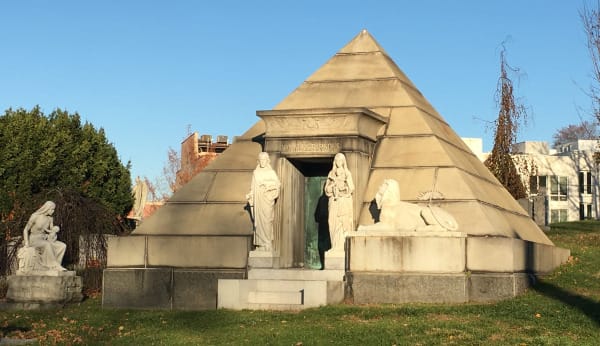
Last summer, my family met in Davenport, Iowa, for the annual Bix Beiderbecke jazz festival and to visit graveyards. Well, a little more than that, but those were the two main activities. Beiderbecke was a contemporary of my grandfather, who also grew up in Davenport, and today they are neighbors at the Fairmount Cemetery.(2) One of the jazz festival’s featured concerts each year takes place at the site of Bix’s grave.
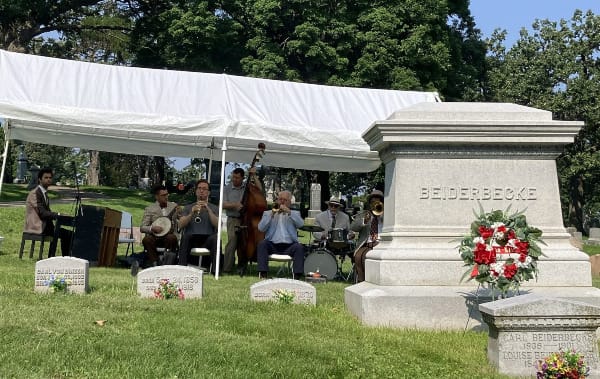
On the one hand, that’s unusual. On the other hand, Fairmount, like Green-Wood, was built in the 19th century when there was a movement in the United States to create cemeteries as green spaces in the city. The Green-Wood website says:
Crowds flocked there to enjoy family outings, carriage rides, and sculpture viewing in the finest of first generation American landscapes. Green-Wood’s popularity helped inspire the creation of public parks, including New York City’s Central and Prospect Parks.
Green-Wood was not the first “rural cemetery” in the United States - Wikipedia gives that honor to Mount Auburn in Boston - but it was surely one of the most influential. It was laid out by David Bates Douglass, who had a hell of a career. He served in the War of 1812, taught at West Point for 15 years, and designed various railroads and canals and a water system in New York City. After building Green-Wood, he went on to become president of Kenyon College. He applied the skills honed at Green-Wood while at Kenyon, most notably laying out the college’s Middle Path paving it with gravel and lining it with Norway maples from the main building, Old Kenyon, to the college gate - now called the Douglass Gates - at the village of Gambier.(3)
When I was a student at Kenyon there was a prominent beech tree in front of the old library that came down when the library was expanded. I imagine it may have been planted at Douglass’s direction; he seems to have had an affinity for them. Green-Wood is full of huge beeches, including a line of them along Fifth Avenue, ten or fifteen feet above the street atop a stone embankment. I love beech trees, and whenever I encounter one at Green-Wood it makes me feel connected to home.
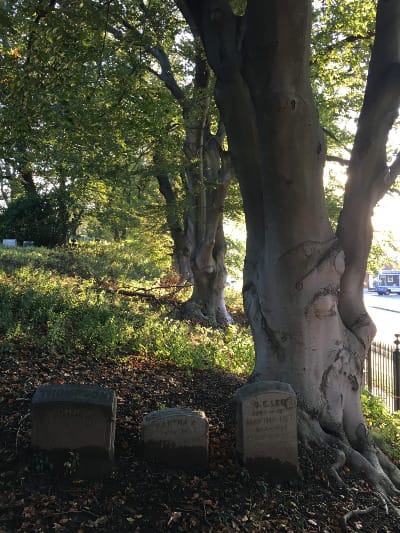
Here is what Hal Borland says of the American Beech in his wonderful survey of trees, A Countryman’s Woods:
Beeches are particularly handsome trees with their big, smooth boles, smoky-gray bark, wide-spreading branches, and almost luminous leaves. ... The leaves are elliptical, short-stemmed, and prominently veined. Each vein ends in a marginal tooth. But it is the texture of the leaves that makes them unique. They are almost translucent. In the summer the sun shines through them, but not the heat. In early autumn they turn a clean, soft yellow. As autumn advances, some but by no means all the beech leaves fall. Those that remain turn almost white - phantom leaves, soft as facial tissue - and cling there through the winter.(4)
Borland observes that the bark invites carved initials. The beech in front of Kenyon’s library was full of initials; so are those at Green-Wood.
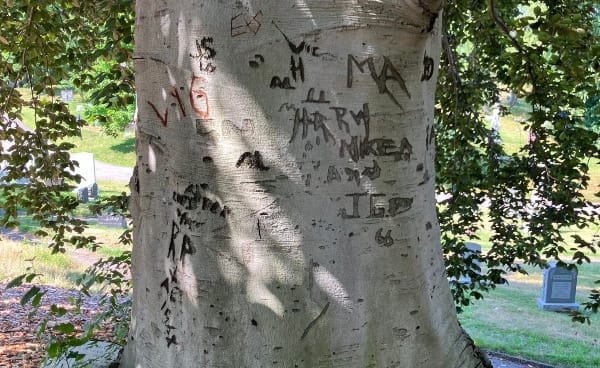
So: the Weedons.
I don’t know why their tombstone caught my eye, except that it happened to be right in front of me as I walked up a hill, and it’s a nice clean one. A lot of families, even ostensibly wealthy ones, made poor choices when it came to stone. The Freeborn family, for example.
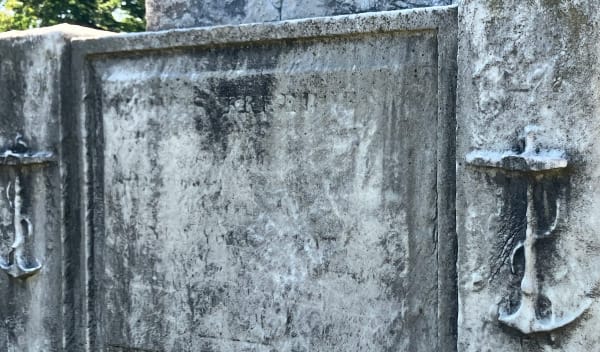
The name Freeborn is legible on the opposite side, and on other markers around. Whatever else they wanted posterity to know has been eroded away.
But some member of the Weedon family chose well. Besides the marker being legible, it merited a second look because Elizabeth is named but not her husband, William, “of England.” I presume he was not only born there but died there as well, and Elizabeth for whatever reason emigrated to the United States. She would have done that sometime after 1852, since her youngest child - youngest named here, at least - was born that year in England. We could find out when, but sometime in the twenty years between her arrival and her death the United States fought a great civil war. That makes it seem likely that she would have arrived before 1861 or after 1865 - but for that, I have no idea how the war affected immigration. An interesting question.
I was thinking about the war because Elizabeth’s son William (Junior) died so young - just nineteen years old. But that came after the war had ended - he would have been just twelve in 1865, so he wasn’t a soldier, I presume. I wondered whether there was an epidemic of some sort in the early 1870s. In Green-Wood, certain years show up more than others on the markers, especially the Civil War years and World War I, which also coincided, as we now know too well, with the Spanish flu pandemic. Up to now, however, I haven’t been looking for the 1870s.
William died before his mother. And so that’s part of the story, too, a chapter of grief and heartache. She died just three years later, young herself, at 55. (Curiously, the tombstone doesn’t list a birthdate - only the date of Elizabeth’s death.)
Elizabeth the daughter, though, lived a full life to the age of 83. She married. Although the marker names her husband William H. Harrison, he does not appear to be buried here. I can only speculate as to why, but it seems most likely that he survived her - and didn’t make provision, on the tombstone at least, for himself. At the time I didn’t look around for a neighboring marker for William H.’s grave. Perhaps there is one, or perhaps it simply didn’t matter to him, or perhaps he was no longer capable of making such a choice.
More curious: Elizabeth the daughter is listed with her maiden name - not as “Elizabeth Weedon Harrison,” which would be more common. There is another story here, but one with as many loose threads as facts we can surmise.
Does any of matter? I’ve never heard of the Weedons, and as far as I know they weren’t especially prominent, although they did well enough to afford Green-Wood in the late nineteenth century. I could look them up, I’m sure; any number of tools would let me do that. The mysteries hold more pleasure than the truth, though. A mausoleum not too far from the Weedons, for example, was obviously built at great expense. It sits atop a hill; it makes a statement. And yet, the family responsible for it offer only the initial “M” as a clue.
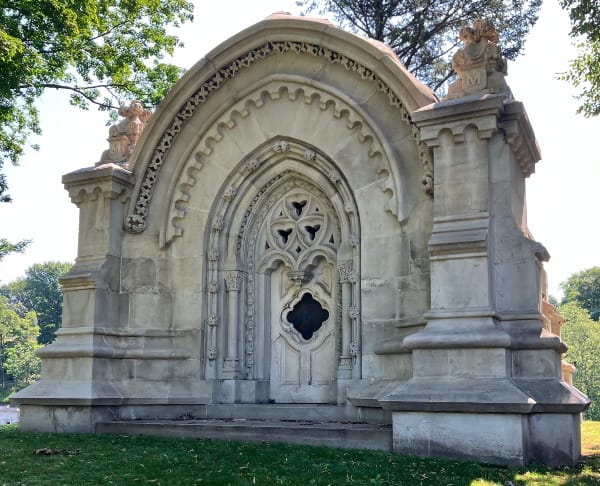
All of these stories, only hinted at. Every one of them equally meaningful, every one of them leading to the same place.
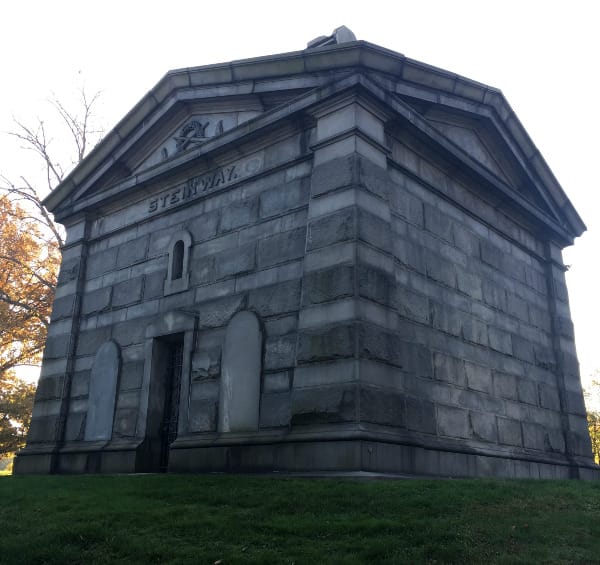
“It is the ambition of the New Yorker,” wrote a newspaper editor named Henry J. Raymond, “to live upon Fifth Avenue, to take his airings in Central Park, and to sleep with his fathers in Green-Wood.” I’ve probably mentioned that quote in some other post. Raymond’s comment might as well have been an advertisement for the cemetery. In any case, as noted, the prominent took his advice. The Steinways have a particularly imposing tomb.
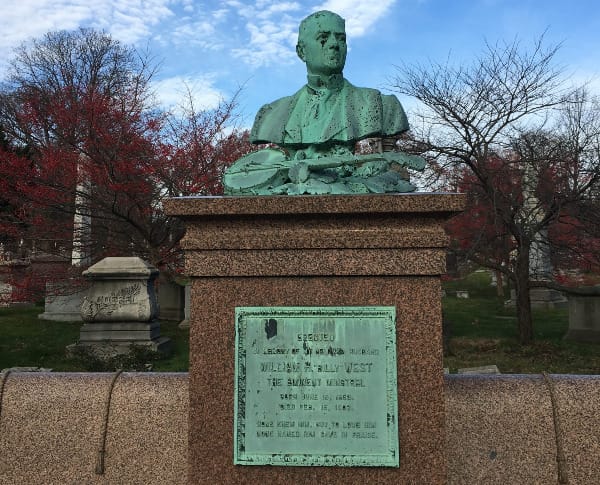
George Tilyou, who built Steeplechase Park at Coney Island, rests at Green-Wood. So does Billy West, whom you may never have heard of, but who was, his grave informs, “the eminent minstrel.” I’m not sure his performances were as praiseworthy as the plaque would have you believe.
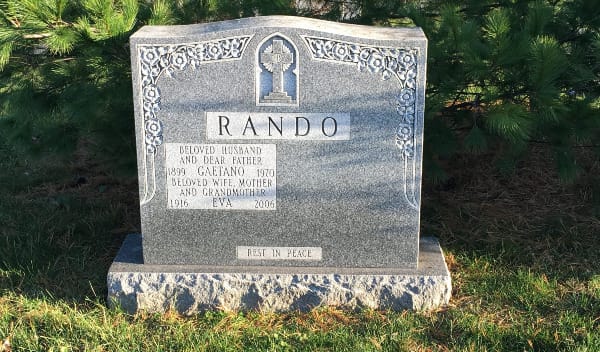
Equally, you might come upon a rando.
My friend Martha for many years staged an elaborate dance performance at Green-Wood called “Angels and Accordions.” I never saw it; she and the company last performed it while I was still in my graveyards-are-creepy phase. But among other things, it planted in my consciousness the existence of Minerva.
Minerva is a statue of the Roman goddess of wisdom, justice, law, and several other things. She stands atop the highest point in Green-Wood, which is in fact the highest point in Brooklyn. It was at this spot that the first battle of the newly declared United States was fought, the Battle of Long Island - more commonly known now as the Battle of Brooklyn. You can read the facts at the Wikipedia page, but the romantic version is that General Washington sent his best troops, from the Delaware and Maryland regiments, to defend that key position, and their valiant stand bought the Continental Army enough time to escape across the East River to Manhattan, and from there up the Hudson to West Point. As much of a rout as the battle was - “slaughter” would not overstate it - the successful retreat enabled the Americans to fight another day.
So there Minerva stands, placed on Battle Hill in 1919 - the year following the end of the Great War, the world still in the midst of that earlier pandemic. Her right hand rests on a monument labeled the Altar to Liberty; her left hand is raised in salute to the statue across the harbor.
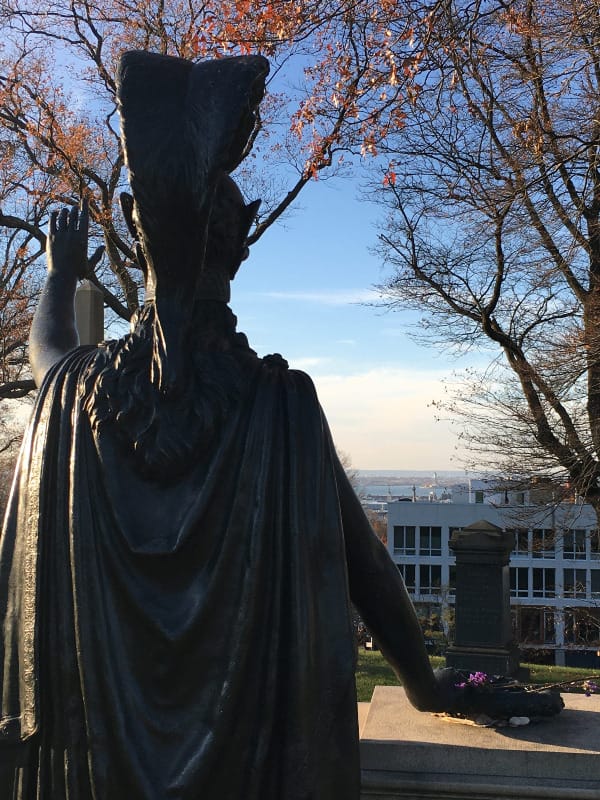
Several years ago a controversy arose over plans to build an apartment building that would have interrupted Minerva’s view of the Statue of Liberty. At the time I thought it typified the silly obstructionism of New Yorkers to more or less everything.
Now, having located the site - it took me a few tries - and having since climbed to see her almost every time I visit Green-Wood, I find the symbolism of the two statues quite moving: a reminder to continue to aspire to the ideals put down on paper 250 years ago.
(1) They say “in America,” actually, but we’ve talked about that.
(2) Bix Beiderbecke lived what you might charitably call a reckless life. His parents sent him off to boarding school to try to forestall the behavior associated with jazz and liquor, but it didn’t work. He died at the age of 28 in Queens, and although the official cause of death was pneumonia, the truth is that he drank himself to death.
(3) Middle Path remains paved with gravel today, problematic in February to all and year-round to anyone with a disability that impairs their walking. There have been proposals to replace the gravel with modern pavement, which I have to say have merit, but so far tradition has carried the day.
Many of the Norway maples, for their part succumbed to disease a few years ago. Douglass perhaps wasn’t thinking far enough into the future by planting so many trees of the same species.
(4) A Countryman’s Woods, p. 72. Borland could really write.